A science-backed guide to understanding The 4 Communication Styles, breaking bad conversational habits, and mastering assertive communication in everyday life.

The “Fine, Whatever” Trap
Mastering the 4 communication styles is the single most effective way to break passive-aggressive habits and express your needs clearly.
Picture this: It’s 8:30 PM on a Tuesday. You’ve had a brutal day at work, and your partner asks if you can clean up the dinner dishes that have been piling up in the sink all afternoon. You’re exhausted, irritated, and desperately want to crash on the couch.
Instead of saying, “I’m really exhausted tonight—can we tackle them together tomorrow morning?” you sigh heavily, aggressively bang a frying pan into the sink, and mutter, “Fine. Whatever. I’ll just do it all myself like I always do.”
Sound familiar? Welcome to the human communication mess.
Whether it’s a passive-aggressive Slack message to a colleague, slamming cupboard doors to signal anger, or silently swallowing your needs to avoid “making a scene,” almost everyone falls into unhelpful communication traps. Communication isn’t just about the words you choose; it’s a direct reflection of your nervous system, your childhood conditioning, and your psychological coping mechanisms. According to psychological models of interpersonal behavior, human responses generally cluster into four distinct communication styles: Passive, Aggressive, Passive-Aggressive, and Assertive.
In this deep dive, we’ll break down each communication style, explore what neurobiology, Cognitive Behavioral Therapy (CBT), Neuro-Linguistic Programming (NLP), and behavioral science say about why we use them, and give you a step-by-step protocol to shift toward direct, healthy, and assertive communication.
The 4 Communication Styles: A Side-by-Side Breakdown
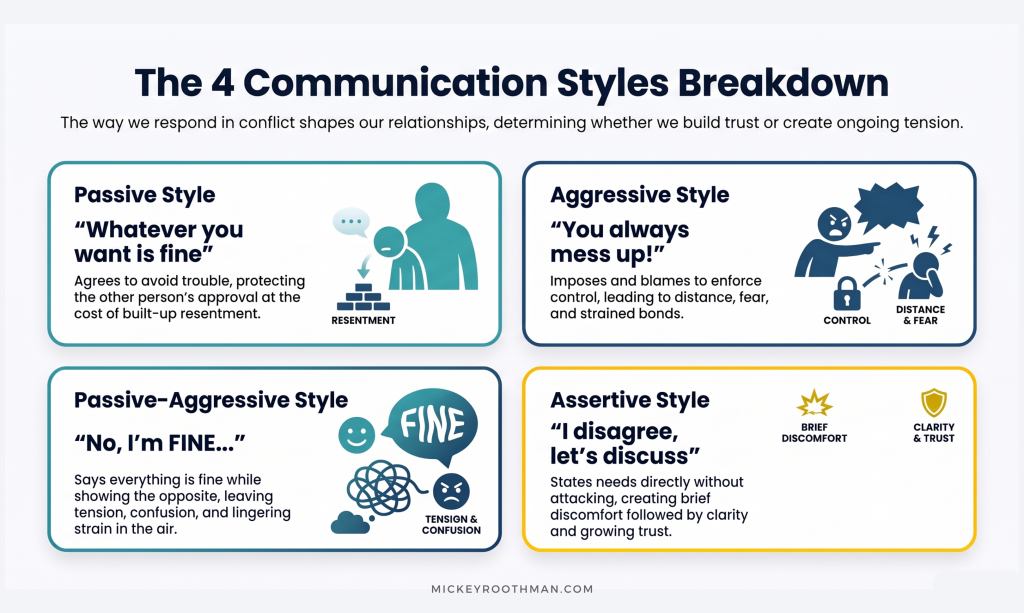
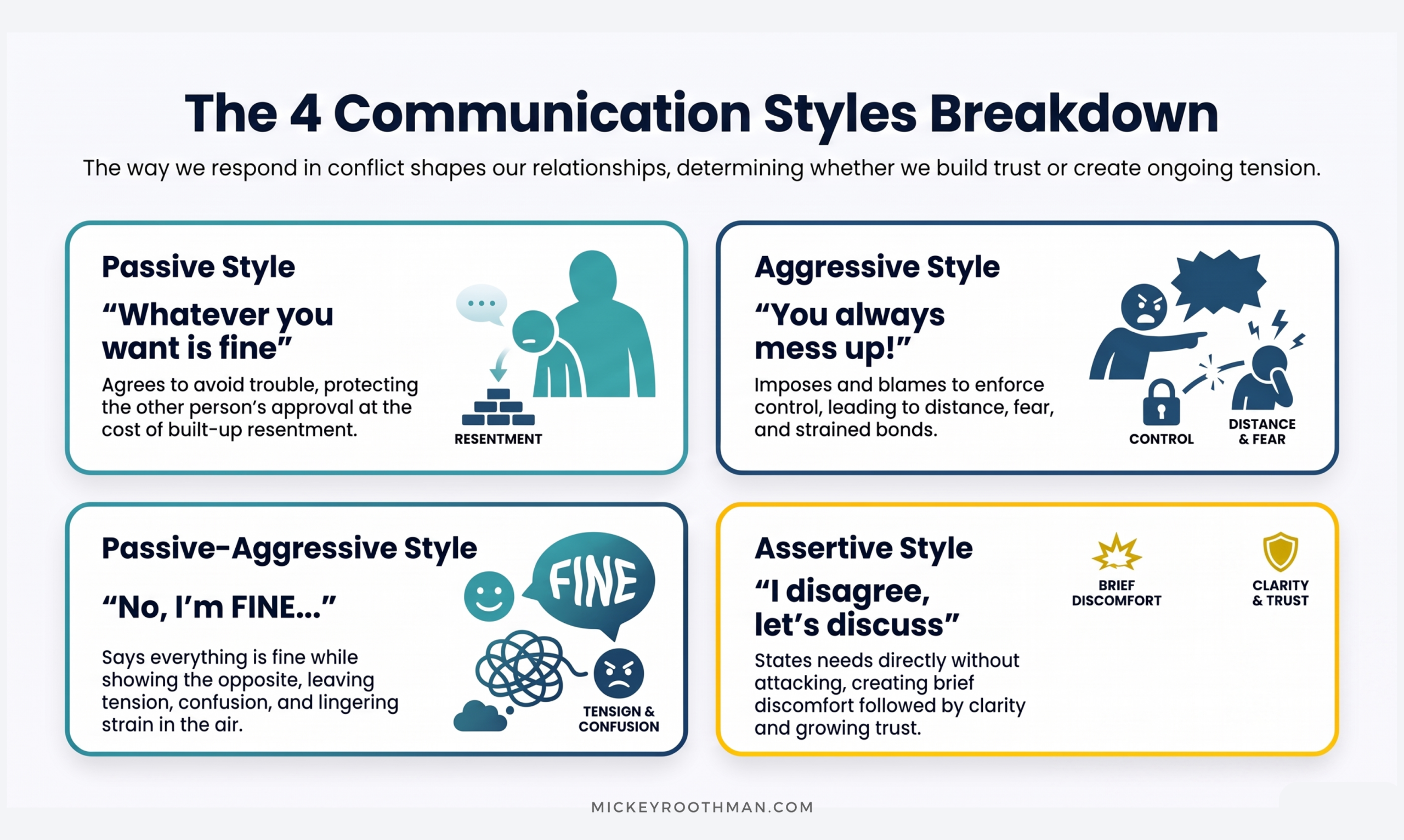
To understand how you communicate and why certain conversations leave you feeling drained or angry, it helps to look at how each of the 4 Communication Styles operates under pressure.
1. Passive Style (The “Approval Seeker”)
- How It Sounds: Passive communicators constantly agree just to avoid causing trouble. They default to phrases like “Whatever you want is fine,” “It doesn’t matter to me,” or “Whatever. It can be.”
- What It Protects: The other person’s approval and short-term harmony.
- The Immediate Effect: The acute conflict is successfully avoided in the moment.
- The Long-Term Cost: Built-up resentment. When you consistently abandon your own preferences to keep others happy, anger doesn’t vanish—it settles into your emotional system, slowly eroding your self-worth and turning into quiet bitterness toward the people you are trying so hard to please.
2. Aggressive Style (The “Controller”)
- How It Sounds: Aggressive communicators impose their views, make sweeping demands, and blame others. They lean heavily on accusatory phrases such as “You never think about me!” or “You always mess this up!”
- What It Protects: A fierce, protective sense of control.
- The Immediate Effect: The demand is usually met right away because others yield out of shock, intimidation, or exhaustion.
- The Long-Term Cost: Distance and fear. While aggression might get quick compliance, it destroys emotional safety. Over time, loved ones and colleagues pull away, walk on eggshells, and withhold genuine connection.
3. Passive-Aggressive Style (The “Stealth Bomber”)
- How It Sounds: Passive-aggressive communicators say everything is completely fine while their non-verbal cues (sighs, eye rolls, silent treatment, delayed responses) show the exact opposite. A classic sample phrase is “Forget it. I’ll just do it myself” or “No, really, I’m FINE.”
- What It Protects: It avoids open, direct conflict while still allowing the person to express their anger.
- The Immediate Effect: Acute confrontation is side-stepped, but a thick layer of unaddressed tension remains hanging in the air.
- The Long-Term Cost: Confusion and strain. It forces the receiver into a guessing game (“Are they mad at me? What did I do?”), which drains psychological safety and creates chronic instability in relationships.
4. Assertive Style (The “Gold Standard”)
- How It Sounds: Assertive communicators state what they need clearly, honestly, and directly—without attacking or belittling the other person. A signature phrase is “I disagree with this approach, but let’s talk about how we can fix it.”
- What It Protects: Both their own individual needs AND the health of the relationship.
- The Immediate Effect: There is often a moment of brief social discomfort, immediately followed by psychological clarity and problem-solving.
- The Long-Term Cost: Trust grows. When people know you say what you mean and mean what you say, they feel safe around you. Resentment clears, boundaries are respected, and intimacy deepens.
The Science Behind It: Why We Communicate the Way We Do
Why do so many smart, caring adults fall back on eye-rolling, silent treatment, or explosive outbursts when uncomfortable topics arise? Science shows it isn’t a personality flaw—it’s a biological and cognitive survival strategy.
1. Neurobiology – Amygdala Hijack & Nervous System States
When a disagreement occurs, your brain’s threat detector—the amygdala—evaluates whether you are safe. If you grew up in an environment where conflict led to emotional abandonment or explosive fights, your brain categorizes direct conflict as an existential threat.
- Aggressive responses are driven by a hyper-activated sympathetic nervous system (Fight). The brain perceives threat and attempts to dominate the environment to achieve safety.
- Passive responses reflect a freeze/fawn response (Fawn). The brain attempts to stay safe by appeasing the perceived threat.
- Passive-aggressive responses are a hybrid: the impulse to fight is present, but the fear of direct confrontation forces the anger underground.
- Assertive communication requires the prefrontal cortex (the rational executive center) to remain online while maintaining a regulated, calm nervous system state.
2. Behavioral Science – Operant Conditioning & Short-Term Rewards
Behavioral psychology explains why these habits are so hard to break: immediate negative reinforcement.
- When you act passively, the painful discomfort of a potential argument immediately stops. Your brain registers: “Phew! Being passive saved us from pain!” The habit gets reinforced.
- When you act aggressively, the other person backs down immediately. Your brain registers: “Aggression gets results!” The habit gets reinforced.
- However, behavioral science emphasizes that while non-assertive strategies yield short-term relief, they create massive long-term costs.
3. Cognitive Behavioral Therapy (CBT) – The Distortion Loop
CBT demonstrates that our communication styles stem directly from core beliefs and cognitive distortions:
- Catastrophizing: “If I tell my boss I can’t take on another project, I’ll be fired immediately.” (Drives passivity).
- Mind Reading: “If they really cared about me, they would just know why I’m upset without me asking.” (Drives passive-aggressive behavior).
- All-or-Nothing Thinking: “Either I win this argument completely, or I am weak.” (Drives aggression).
4. Neuro-Linguistic Programming (NLP) – Universal Quantifiers & Linguistic Triggers
In NLP, aggressive and passive-aggressive patterns heavily rely on Universal Quantifiers (words like always, never, everyone, nobody).
- “You NEVER help around the house!”
- “You ALWAYS ignore my input!”
These linguistic patterns trigger immediate defensiveness in the listener because they attack character rather than specific behaviors. NLP focuses on shifting language from vague character attacks to sensory-grounded, specific observations.
Why You Should Choose To Shift To Assertive Communication
Staying stuck in passive, aggressive, or passive-aggressive communication isn’t just unpleasant—it carries measurable psychological and physiological costs.
- Emotional Health: Suppressing your true thoughts (passivity) raises baseline cortisol levels, contributing to chronic anxiety, low mood, and burnout.
- Physical Health: Holding onto unexpressed anger (passive-aggression) manifests as somatic tension— jaw clenching, tension headaches, GI distress, and muscle tightness.
- Relationship Longevity: Research in couples psychology consistently shows that contempt and passive-aggressive stonewalling are primary predictors of relationship dissolution. Conversely, experiencing the brief discomfort of direct honesty builds enduring trust.
How To Make The Shift: The 4-Step Assertiveness Protocol
Assertiveness is not an inherent trait you are born with—it is a trainable behavioral skill. Use this 4-step framework to practice direct communication in your daily life.
Step 1: The Somatic Pause (Regulate the Amygdala)
Before speaking, take a 5-second physiological sigh (two quick inhales through the nose, one long exhale through the mouth). This signals to your autonomic nervous system that you are safe, allowing your prefrontal cortex to guide your words rather than an activated survival state.
Step 2: Challenge the Cognitive Distortion (CBT Reframing)
Ask yourself:
- “What am I afraid will happen if I speak directly?”
- “Is it true that directness will destroy this relationship, or am I avoiding brief discomfort?” Remember: Assertiveness trades short-term discomfort for long-term clarity .
Step 3: Use the NLP “I-Statement” Formula
Replace character attacks (“You’re so lazy!”) or indirect hints (“Must be nice to relax all day…”) with this 4-part clear structure:
1. Observation (Specific, sensory-grounded, neutral): “When I see dishes left in the sink after dinner…”
2. Feeling (Internal state without blame): “…I feel overwhelmed and unsupported…”
3. Need (Clear underlying value): “…because I need a clean space to unwind in the evening…”
4. Request (Actionable, specific, positive): “…Would you be open to clearing the sink before 9 PM tonight?”
Step 4: Embrace the Brief Discomfort
Expect a momentary surge of awkwardness or anxiety when you state a direct boundary or disagreement. REMIND YOURSELF: Brief discomfort is the price of admission for long-term trust and peace of mind.
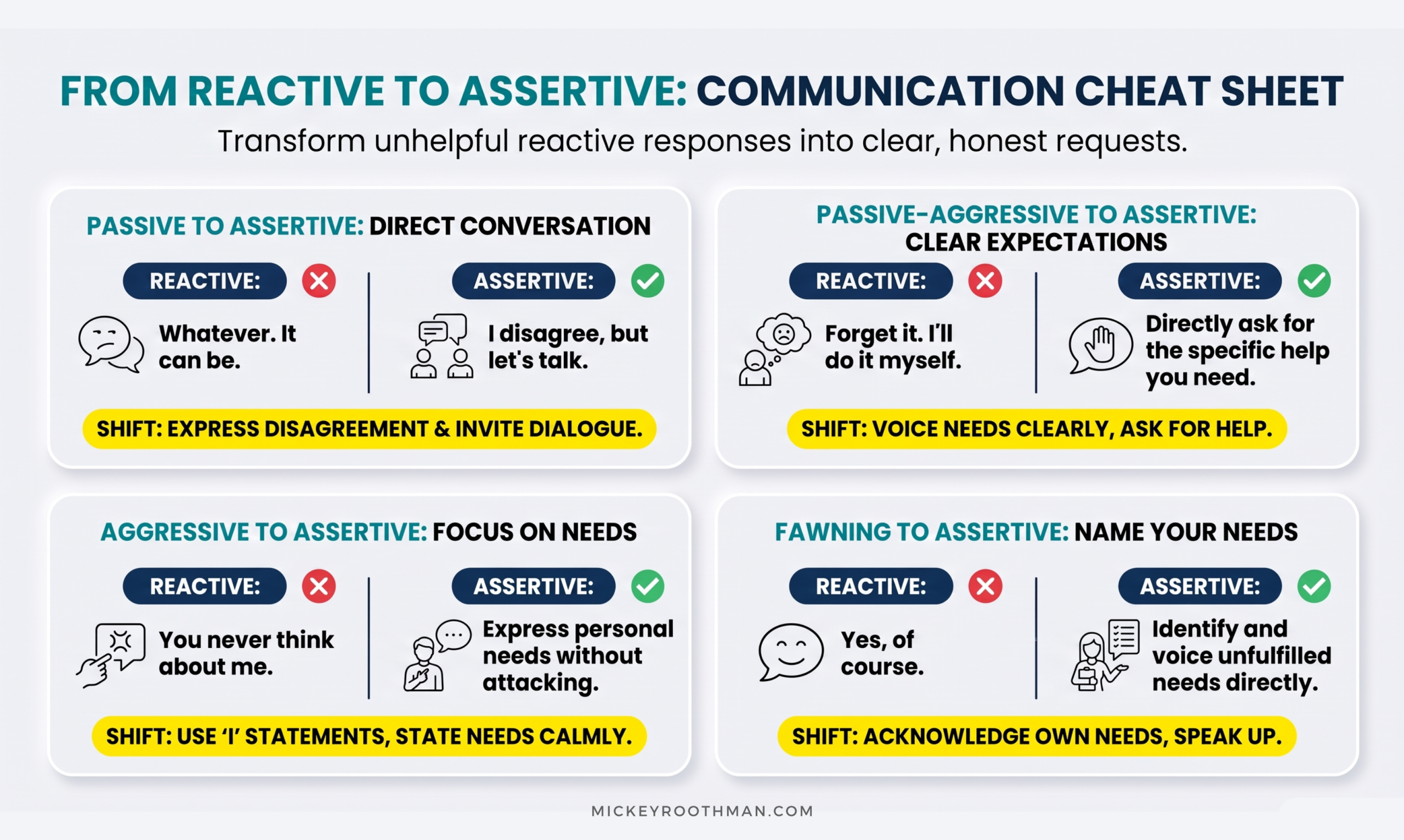
Real-World Cheat Sheet – Transforming Everyday Phrases
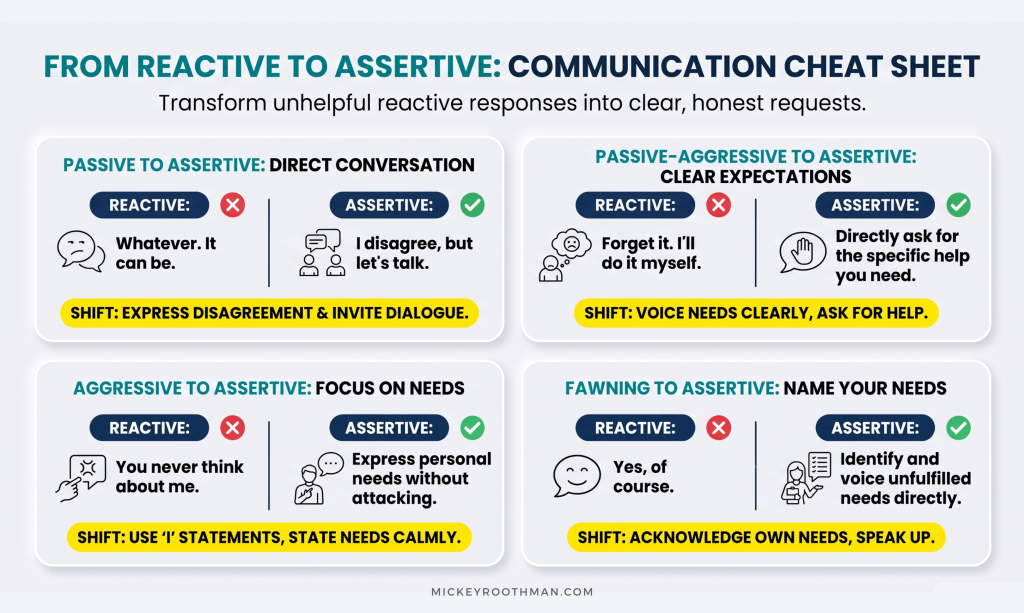
Theory and understanding a concept is one thing. Using it in everyday life (or remembering it for that matter in the moment when you need it) takes practice. But don’t worry – I’ve got you! Here is an easy to use Cheat Sheet to help you practice and transform your everyday phrases, in real time.
Key Takeaways & FAQ’s:
What is the main difference between passive-aggressive and assertive communication?
Passive-aggressive communication attempts to express anger indirectly while avoiding direct conflict. Assertive communication directly addresses needs and boundaries while treating the other person with respect, trading brief discomfort for long-term trust and clarity.
Can someone be both passive and aggressive?
Yes! Many people cycle between passive and aggressive styles. They swallow their feelings passively until their resentment reaches a boiling point, resulting in an aggressive blow-up, followed by guilt that pushes them right back into passivity.
How do I deal with a passive-aggressive colleague or partner?
Do not play into the guessing game. Address the non-verbal behavior calmly and directly: “You mentioned everything is fine, but I noticed your tone sounded frustrated. I’m open to hearing what’s on your mind so we can figure it out together.”
CONCLUSION: Say What You Mean – Mean What You Say
Communication is a muscle. You won’t master assertiveness overnight, especially if you’ve spent decades pleasing others or using aggression to feel safe.
Start small. Pick one low-stakes situation this week, like ordering food, declining a minor social invite, or asking for a clarification at work — and practice speaking your truth (always from a space of love) directly. You’ll quickly find that the brief discomfort of honesty is infinitely lighter to carry than the heavy weight of built-up resentment because you didn’t.
Thank you for taking the time to invest in your personal growth and self awareness. If you found this information valuable and you know someone that would get value from it too, please hit the forward or share button now. For more tools and resources you can listen and subscribe to my Breakthrough Podcast Show Here.


 If you believe that it has to be difficult and that you have to struggle to have the life that you want, I want to assure you today from experience that you don’t have to struggle to be happy, successful or whatever it is you desire.
I’ve seen proof of it over and over again in my own life and in the lives of many of my clients once they lay down and let go of this belief that has been projected onto us by society.
I want you to choose today, right here right now, to let go of that idea and that belief. I want you to choose today to believe that you can create and have the life that you want with total ease and joy!
If you believe that it has to be difficult and that you have to struggle to have the life that you want, I want to assure you today from experience that you don’t have to struggle to be happy, successful or whatever it is you desire.
I’ve seen proof of it over and over again in my own life and in the lives of many of my clients once they lay down and let go of this belief that has been projected onto us by society.
I want you to choose today, right here right now, to let go of that idea and that belief. I want you to choose today to believe that you can create and have the life that you want with total ease and joy!