
When Your Mind Won’t Shut Up – 4 Types Of Worry (And How To Quiet Overthinking)

Woman lying down with clock overthinking

It’s 1:47 AM. Your phone’s face-down on the nightstand, the room’s pitch black, and by all logical accounts, you should be sound asleep.

Instead, your nervous system’s hosting an uninvited late-night symposium.

One night, your mind’s racing three months ahead, inventing elaborate worst-case scenarios about a routine workplace performance. And the next, you’re mentally replaying an awkward comment you made in a group chat a week ago. On the third night, you’re obsessively drafting a color-coded task list for a weekend trip that isn’t happening for three more weeks. And on the fourth, every sudden creak of the floorboards or unexpected phone notification ping sets off a spike of physical adrenaline.

And by night 5 you’re beyond exhausted, both physically and mentally, but your brain still won’t switch off and let you get some rest!

We tend to throw all of these different uncomfortable mental states into one giant bucket and label it “overthinking.” But in behavioral psychology and cognitive neuroscience, your brain’s actually cycling through four very distinct types of worry: Chronic Worry, Mental Rumination, Obsessive Planning, and Environmental Hypervigilance.

While each loop feels identical from the inside: flooding your body with restlessness and keeping your brain on high alert, they look in completely different directions, seek different goals, and actually require entirely different cognitive circuit breakers to silence and shut down.

Understanding which of the four loops your brain’s running in a given moment, is the ultimate key to turning off the noise, regaining emotional control, and finally getting a full night’s sleep.
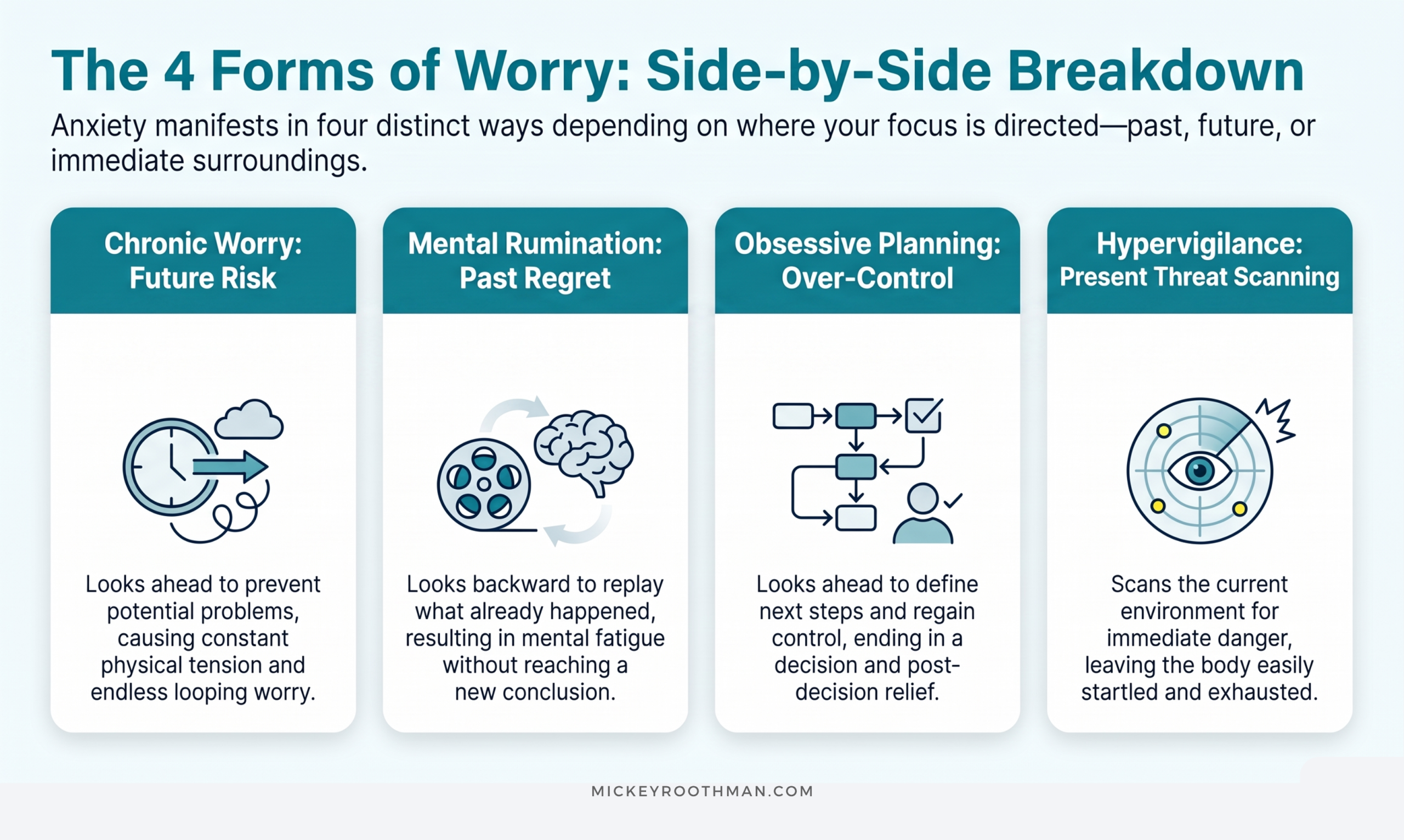

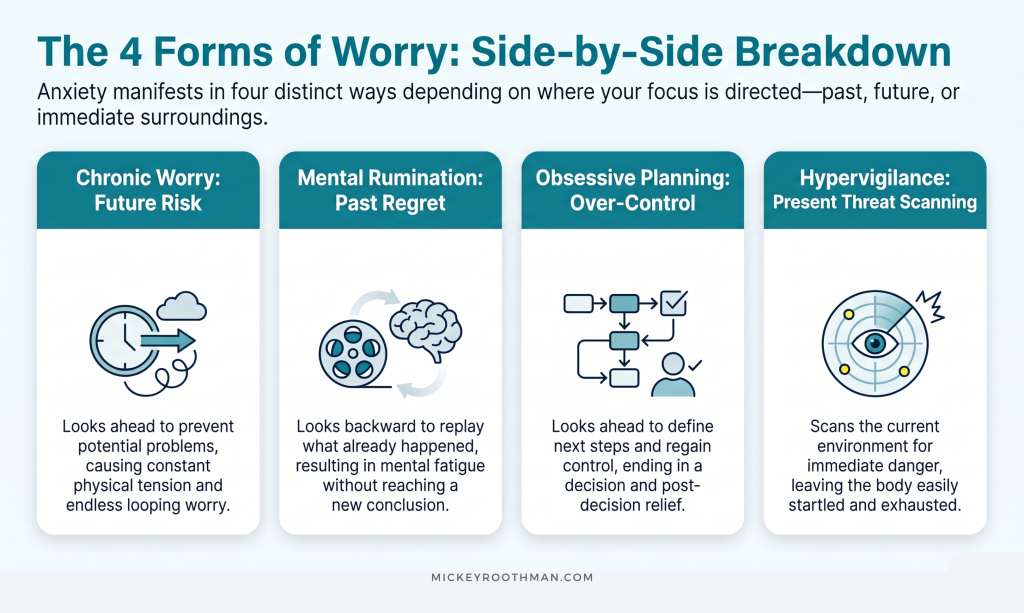
Comparison diagram of the 4 types of worry showing worry, rumination, planning, and hypervigilance.
Download Infographic Here

1. Chronic Worry -The Future-Focused “What-If” Machine

Worry is an anticipatory mental pattern directed exclusively toward the future. It’s driven by uncertainty and fueled by potential catastrophes that haven’t occurred yet.

Where Your Mind “Looks”:

Directly ahead into tomorrow, next month, or five years from now.

What Your Brain Is Trying To Do:

Worry is your brain’s attempt at proactive threat management. When your amygdala (the brain’s emotional alarm center) senses that an upcoming event contains unknown variables, it prompts your prefrontal cortex to construct dozens of hypothetical disaster scenarios. The underlying logic is simple: “If I can predict every single thing that could go wrong, I won’t be caught off guard.”

Real-World Example:

You see a calendar invite appear from HR titled “Quick Catch-Up,” scheduled for tomorrow afternoon. Even though your recent work’s been stellar, your mind instantly spins a web of hypothetical disasters: “What if layoffs are starting? What if I miscalculated our quarterly figures? Should I start updating my resume right now?”

The Neurological Trap:

Because worrying feels like you’re actively working on a problem, your brain misinterprets the mental strain as productive preparation. It rewards the habit with a temporary illusion of control; all the while still continuously pumping cortisol into your bloodstream and stacking up physical tension in your shoulders.

Woman Looking Forward Looking Worried, Ruminating, Planning, Overthinking


2. Mental Rumination – The Past-Focused “Why-Me” Replay

Rumination is a retrospective mental loop directed entirely toward the past. Rather than anticipating future risks, rumination continuously re-examines past events, mistakes, or perceived awkward interactions

Where Your Mind “Looks”:

Backwards into yesterday, last week, or even years or decades into your past.

What Your Brain Is Trying To Do:

While worry attempts to control the future, rumination attempts to rewrite history or assign personal blame. Driven by feelings of shame, regret, or grief, your brain enters an endless analytical loop, operating under the false belief that if you replay an uncomfortable conversation just one more time from a slightly different angle, you’ll unlock a hidden insight that retroactively erases the emotional discomfort.

Real World Example:

You left a team Zoom call three hours ago, but you’re still sitting on the couch replaying the exact moment you stumbled over your presentation slide. “Why didn’t I phrase that better? Everyone probably noticed how nervous I looked. Sarah smiled right after I spoke. Was she laughing at me?”

The Neurological Trap:

Unlike healthy self-reflection, which leads to a clear insight or closure, rumination never reaches a satisfying conclusion. It simply deepens the neural pathway of self-criticism, dragging your mood down and convincing you that past errors define your current worth.


3. Obsessive Planning – The Control-Driven “Action” Trap

Planning is a future-oriented cognitive process designed to organize tasks and define next steps. When functioning healthily, planning is a vital executive skill. However, when hijacked by underlying anxiety, it transforms into Obsessive Planning – a subtle, sneaky form of worry disguised as productivity.

Where The Mind “Looks”:

Toward future projects, schedules, logistics, spreadsheets, and task lists.

What Your Brain Is Trying To Do:

Obsessive planning seeks to eliminate the discomfort of life’s unpredictability by micromanaging every single detail. It promises that if you create the ultimate color-coded schedule, research twenty different product reviews, or draft every possible email response in advance, nothing unexpected can disrupt your peace.

Real-World Example:

Instead of relaxing on a Sunday evening, you spend three straight hours building a hyper-detailed, minute-by-minute itinerary for an upcoming family weekend, frantically opening twenty browser tabs to research dinner options, traffic predictions, and backup indoor activities in case it rains.

The Neurological Trap:

Planning feels responsible and disciplined, which makes it hard to recognize as an anxiety habit. However, when planning is driven by fear rather than genuine necessity, completing the plan doesn’t bring peace; it simply exposes five new potential logistical problems to fixate on.

Overthinking and planning overwhelmed man covered in papers


4. Hypervigilance – The Present Moment “Danger-Scan”

Hypervigilance is a state of heightened sensory awareness directed at your immediate environment right now. Unlike worry or rumination, which live in your thoughts, hypervigilance lives in your physical nervous system.

Where Your Mind “Looks”:

Outward into your immediate surroundings, phone screens, physical sensations, or interpersonal cues.

What Your Brain Is Trying To Do:

Hypervigilance seeks to detect instant, incoming threats before they land. Rooted in past stress or chronic overload, your autonomic nervous system remains stuck in a fight-or-flight state, scanning every room, Slack message tone, or physical symptom for signs of impending conflict or danger.

Real-World Example:

Your partner or roommate responds to your text with a short, one-word answer like “Okay”. Your chest instantly tightens, your heart rate accelerates, and you spend the next twenty minutes scrutinizing every interaction from the morning to figure out if they’re secretly furious with you.

The Neurological Trap:

Hypervigilance drains immense physical and mental energy. Because your nervous system is constantly looking for threats, it interprets totally neutral signals like for example a delayed email response, a quiet tone of voice, or a sudden floorboard sound, as active danger – keeping you physically exhausted yet mentally wired.


Break The Worry Loop – The 3 Step Circuit Breaker

Regardless of which loop your brain is currently running, trying to brute-force yourself into not thinking never works. Instead, use this 3-step evidence-based CBT protocol to break the momentum:
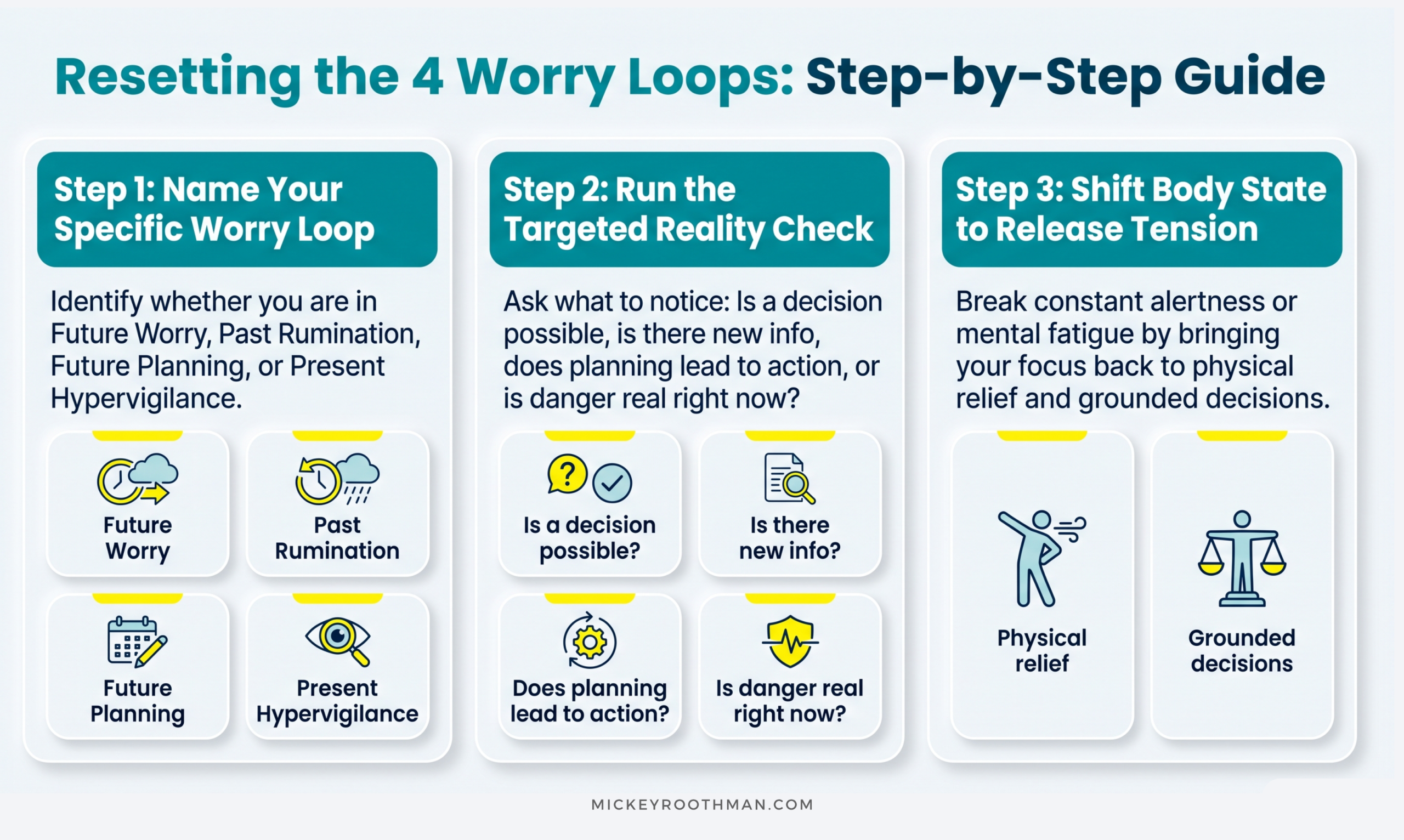
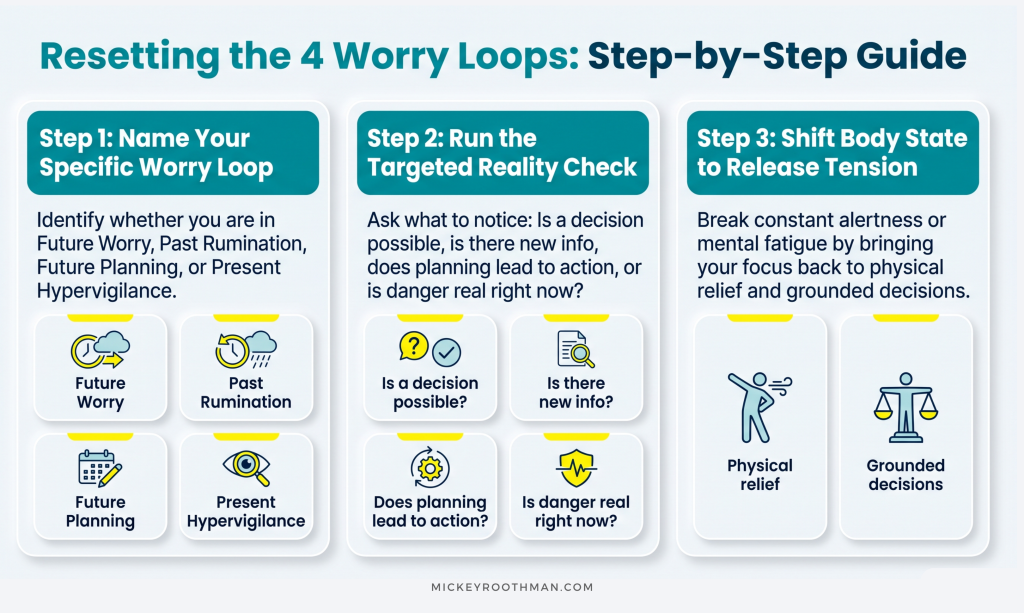
Step-by-step infographic showing how to break the 4 types of worry loop with a 3-step reset protocol.
Download Infographic Here

Step 1: Name The Loop Out Loud

The moment you feel your mind spinning, step back and label the exact pattern running:

  • “This is future worry spinning hypothetical stories.”
  • “This is past rumination replaying yesterday.”
  • “This is obsessive planning trying to force control.”
  • “This is hypervigilance scanning for danger that isn’t here.”

By naming the process out loud, you practice cognitive defusion; a core principle in Cognitive Behavioral Therapy (CBT) and Acceptance and Commitment Therapy (ACT).

Labeling shifts brain activity away from the emotional amygdala and reactivates the rational prefrontal cortex, creating instant emotional breathing room.

Step 2: The 3-Minute Reality & Action Check

Next, ask your mind the specific diagnostic question tailored to your active loop:

For Worry or Planning:

“Can I make a physical decision or take a 2-minute action right now?”

If yes, write down the single next step and schedule it.

If no, declare the topic off-limits until daytime hours.

For Rumination:

“Is there any new information to discover here, or am I just punishing myself?”

Recognize that replaying the tape won’t change the past, and grant yourself permission to step away.

For Hypervigilance:

“Am I in physical danger right now in this room?”

Orient your eyes to three solid objects around you to anchor your brain in present safety.

Step 3: Somatic 4-7-8 Breathing (Nervous System De-escalation)

Because worry loops trick your body into thinking you’re in physical danger, you must send a physiological safety signal down your Vagus Nerve to shut down the adrenaline pipeline. And this is a fast and effective way that you can do anywhere, to deliver that signal:

  1. Inhale quietly through your nose for 4 seconds.
  2. Hold your breath gently for 7 seconds.
  3. Exhale slowly and completely through your mouth for 8 seconds, letting out a soft “whoosh.”

Repeat this cycle four times. The extended 8-second exhale activates your parasympathetic nervous system, slowing your heart rate and signaling to your brain that it’s safe to power down.


Key Takeaways:

  • Not All Overthinking Is the Same – Overthinking manifests as Chronic Worry (future threat), Mental Rumination (past regret), Obsessive Planning (over-control), or Hypervigilance (present threat-scanning).
  • Worry Offers False Protection – Your brain runs these loops because it believes they offer safety, control, or resolution—even though they actually produce physical exhaustion and mental fatigue.
  • Labeling Breaks the Spell – Simply naming the specific loop out loud detaches your identity from the thought and reactivates your rational brain.
  • Grounding Restores Calm – True relief comes from shifting out of the mental loop using targeted diagnostic questions and somatic nervous system grounding.

Frequently Asked Questions:

Can my brain cycle through multiple types of worry in a single evening?

Absolutely. It’s very common for hypervigilance (noticing a colleague’s blunt text) to trigger past rumination (“I always ruin workplace relationships”), which then escalates into future worry (“I’m going to get fired”), ending in late-night obsessive planning (“I need to rewrite all my project guidelines tonight”). Using Step 1 to label each shift helps untangle the web.

How do I tell the difference between healthy planning and obsessive planning?

Healthy planning ends in a concrete decision and a sense of relief. Obsessive planning feels frantic, involves endless researching or tweaking without settling on an outcome, and leaves you feeling more anxious than when you started.

What should I do if I wake up at 2 AM stuck in one of these loops?

Don’t stay in bed trying to “fight” the thought. Sit up, turn on a dim light, and spend 3 minutes writing the thoughts onto a physical notepad. Once written down, tell yourself: “This is safely stored on paper. My brain’s off-duty until 9:00 AM.” Then perform four rounds of 4-7-8 breathing.


If you enjoyed this blog and know someone who would get value from it as well, please hit the share button now.

Ready to dive deeper? Check out the Breakthrough Podcast Here

Read More

Stop Passive-Aggressive Texts: How to Say What You Mean Without Being a Jerk

A science-backed guide to understanding The 4 Communication Styles, breaking bad conversational habits, and mastering assertive communication in everyday life.

4 Communication Styles Mastery

The “Fine, Whatever” Trap

Mastering the 4 communication styles is the single most effective way to break passive-aggressive habits and express your needs clearly.

Picture this: It’s 8:30 PM on a Tuesday. You’ve had a brutal day at work, and your partner asks if you can clean up the dinner dishes that have been piling up in the sink all afternoon. You’re exhausted, irritated, and desperately want to crash on the couch.

Instead of saying, “I’m really exhausted tonight—can we tackle them together tomorrow morning?” you sigh heavily, aggressively bang a frying pan into the sink, and mutter, “Fine. Whatever. I’ll just do it all myself like I always do.”

Sound familiar? Welcome to the human communication mess.

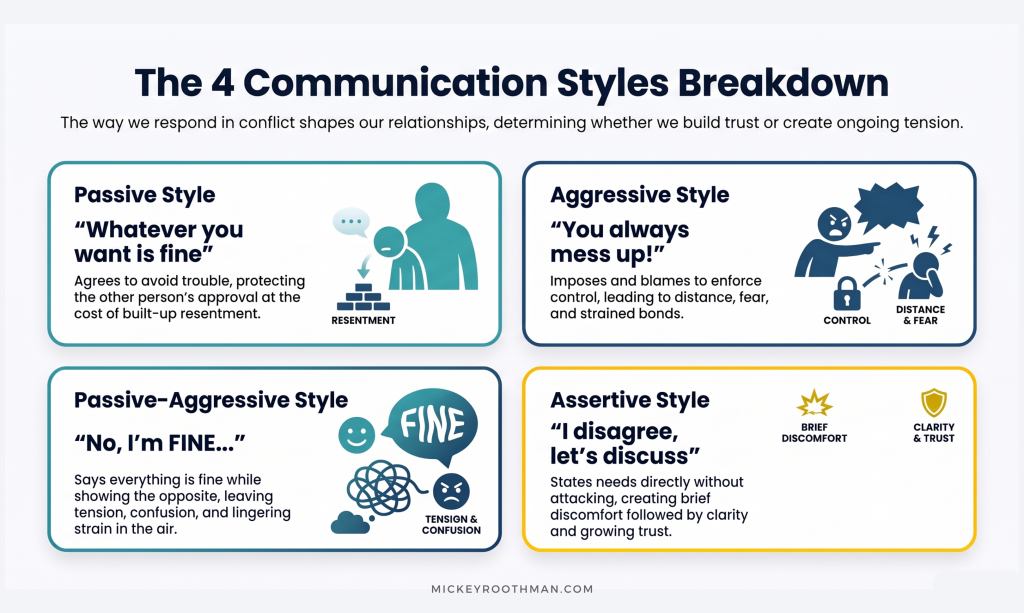
Whether it’s a passive-aggressive Slack message to a colleague, slamming cupboard doors to signal anger, or silently swallowing your needs to avoid “making a scene,” almost everyone falls into unhelpful communication traps. Communication isn’t just about the words you choose; it’s a direct reflection of your nervous system, your childhood conditioning, and your psychological coping mechanisms. According to psychological models of interpersonal behavior, human responses generally cluster into four distinct communication styles: Passive, Aggressive, Passive-Aggressive, and Assertive.

In this deep dive, we’ll break down each communication style, explore what neurobiology, Cognitive Behavioral Therapy (CBT), Neuro-Linguistic Programming (NLP), and behavioral science say about why we use them, and give you a step-by-step protocol to shift toward direct, healthy, and assertive communication.


The 4 Communication Styles: A Side-by-Side Breakdown

To understand how you communicate and why certain conversations leave you feeling drained or angry, it helps to look at how each of the 4 Communication Styles operates under pressure.

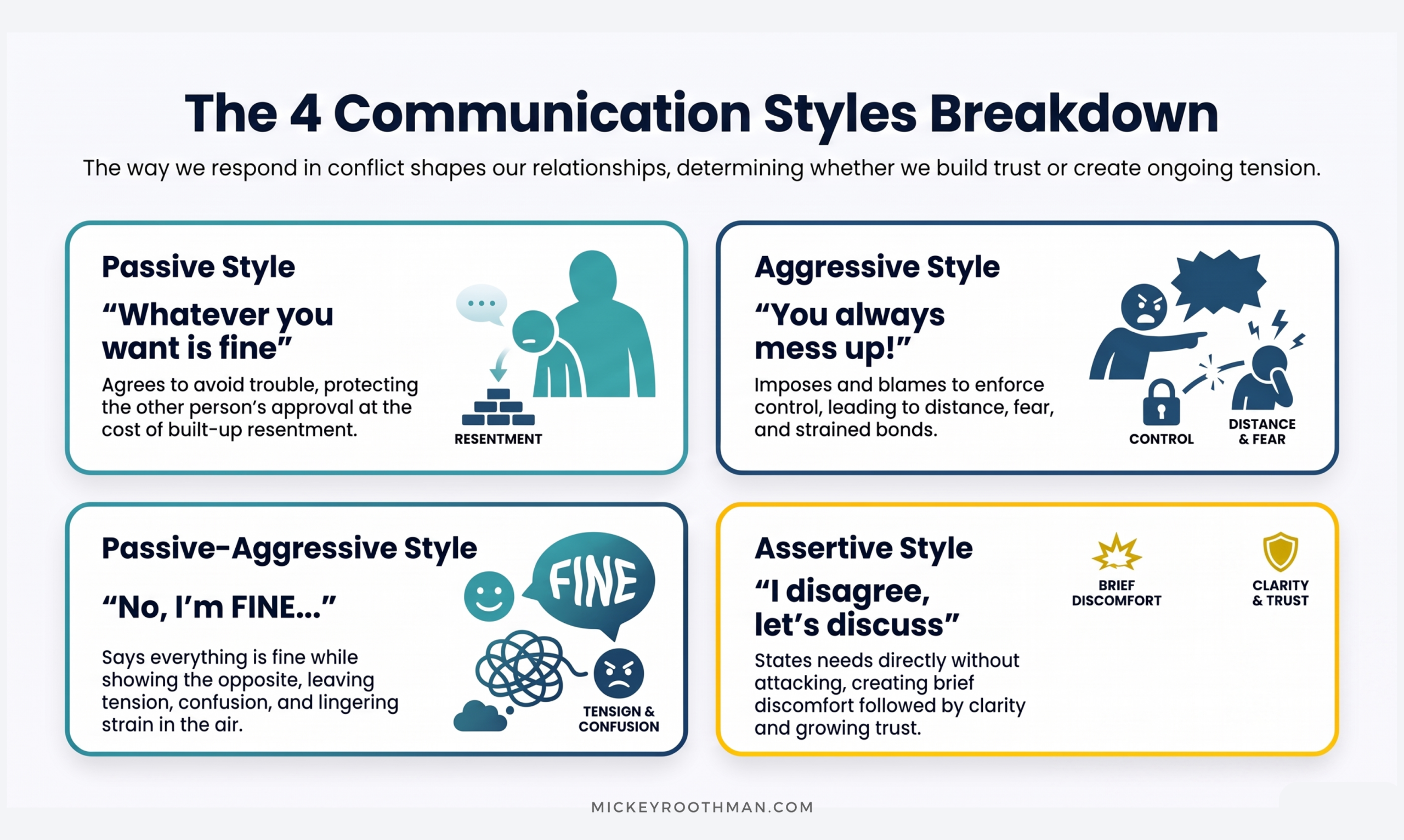
Infographic comparing the 4 communication styles: passive, aggressive, passive-aggressive, and assertive

(Download infographic here)


1. Passive Style (The “Approval Seeker”)

  • How It Sounds: Passive communicators constantly agree just to avoid causing trouble. They default to phrases like “Whatever you want is fine,” “It doesn’t matter to me,” or “Whatever. It can be.”
  • What It Protects: The other person’s approval and short-term harmony.
  • The Immediate Effect: The acute conflict is successfully avoided in the moment.
  • The Long-Term Cost: Built-up resentment. When you consistently abandon your own preferences to keep others happy, anger doesn’t vanish—it settles into your emotional system, slowly eroding your self-worth and turning into quiet bitterness toward the people you are trying so hard to please.

2. Aggressive Style (The “Controller”)

  • How It Sounds: Aggressive communicators impose their views, make sweeping demands, and blame others. They lean heavily on accusatory phrases such as “You never think about me!” or “You always mess this up!”
  • What It Protects: A fierce, protective sense of control.
  • The Immediate Effect: The demand is usually met right away because others yield out of shock, intimidation, or exhaustion.
  • The Long-Term Cost: Distance and fear. While aggression might get quick compliance, it destroys emotional safety. Over time, loved ones and colleagues pull away, walk on eggshells, and withhold genuine connection.

3. Passive-Aggressive Style (The “Stealth Bomber”)

  • How It Sounds: Passive-aggressive communicators say everything is completely fine while their non-verbal cues (sighs, eye rolls, silent treatment, delayed responses) show the exact opposite. A classic sample phrase is “Forget it. I’ll just do it myself” or “No, really, I’m FINE.”
  • What It Protects: It avoids open, direct conflict while still allowing the person to express their anger.
  • The Immediate Effect: Acute confrontation is side-stepped, but a thick layer of unaddressed tension remains hanging in the air.
  • The Long-Term Cost: Confusion and strain. It forces the receiver into a guessing game (“Are they mad at me? What did I do?”), which drains psychological safety and creates chronic instability in relationships.

4. Assertive Style (The “Gold Standard”)

  • How It Sounds: Assertive communicators state what they need clearly, honestly, and directly—without attacking or belittling the other person. A signature phrase is “I disagree with this approach, but let’s talk about how we can fix it.”
  • What It Protects: Both their own individual needs AND the health of the relationship.
  • The Immediate Effect: There is often a moment of brief social discomfort, immediately followed by psychological clarity and problem-solving.
  • The Long-Term Cost: Trust grows. When people know you say what you mean and mean what you say, they feel safe around you. Resentment clears, boundaries are respected, and intimacy deepens.

The Science Behind It: Why We Communicate the Way We Do

Why do so many smart, caring adults fall back on eye-rolling, silent treatment, or explosive outbursts when uncomfortable topics arise? Science shows it isn’t a personality flaw—it’s a biological and cognitive survival strategy.

1. Neurobiology – Amygdala Hijack & Nervous System States

When a disagreement occurs, your brain’s threat detector—the amygdala—evaluates whether you are safe. If you grew up in an environment where conflict led to emotional abandonment or explosive fights, your brain categorizes direct conflict as an existential threat.

  • Aggressive responses are driven by a hyper-activated sympathetic nervous system (Fight). The brain perceives threat and attempts to dominate the environment to achieve safety.
  • Passive responses reflect a freeze/fawn response (Fawn). The brain attempts to stay safe by appeasing the perceived threat.
  • Passive-aggressive responses are a hybrid: the impulse to fight is present, but the fear of direct confrontation forces the anger underground.
  • Assertive communication requires the prefrontal cortex (the rational executive center) to remain online while maintaining a regulated, calm nervous system state.

2. Behavioral Science – Operant Conditioning & Short-Term Rewards

Behavioral psychology explains why these habits are so hard to break: immediate negative reinforcement.

  • When you act passively, the painful discomfort of a potential argument immediately stops. Your brain registers: “Phew! Being passive saved us from pain!” The habit gets reinforced.
  • When you act aggressively, the other person backs down immediately. Your brain registers: “Aggression gets results!” The habit gets reinforced.
  • However, behavioral science emphasizes that while non-assertive strategies yield short-term relief, they create massive long-term costs.

3. Cognitive Behavioral Therapy (CBT) – The Distortion Loop

CBT demonstrates that our communication styles stem directly from core beliefs and cognitive distortions:

  • Catastrophizing: “If I tell my boss I can’t take on another project, I’ll be fired immediately.” (Drives passivity).
  • Mind Reading: “If they really cared about me, they would just know why I’m upset without me asking.” (Drives passive-aggressive behavior).
  • All-or-Nothing Thinking: “Either I win this argument completely, or I am weak.” (Drives aggression).

4. Neuro-Linguistic Programming (NLP) – Universal Quantifiers & Linguistic Triggers

In NLP, aggressive and passive-aggressive patterns heavily rely on Universal Quantifiers (words like always, never, everyone, nobody).

  • “You NEVER help around the house!”
  • “You ALWAYS ignore my input!”

These linguistic patterns trigger immediate defensiveness in the listener because they attack character rather than specific behaviors. NLP focuses on shifting language from vague character attacks to sensory-grounded, specific observations.


Why You Should Choose To Shift To Assertive Communication

Staying stuck in passive, aggressive, or passive-aggressive communication isn’t just unpleasant—it carries measurable psychological and physiological costs.

  • Emotional Health: Suppressing your true thoughts (passivity) raises baseline cortisol levels, contributing to chronic anxiety, low mood, and burnout.
  • Physical Health: Holding onto unexpressed anger (passive-aggression) manifests as somatic tension— jaw clenching, tension headaches, GI distress, and muscle tightness.
  • Relationship Longevity: Research in couples psychology consistently shows that contempt and passive-aggressive stonewalling are primary predictors of relationship dissolution. Conversely, experiencing the brief discomfort of direct honesty builds enduring trust.

How To Make The Shift: The 4-Step Assertiveness Protocol

Assertiveness is not an inherent trait you are born with—it is a trainable behavioral skill. Use this 4-step framework to practice direct communication in your daily life.

Step 1: The Somatic Pause (Regulate the Amygdala)

Before speaking, take a 5-second physiological sigh (two quick inhales through the nose, one long exhale through the mouth). This signals to your autonomic nervous system that you are safe, allowing your prefrontal cortex to guide your words rather than an activated survival state.

Step 2: Challenge the Cognitive Distortion (CBT Reframing)

Ask yourself:

  • “What am I afraid will happen if I speak directly?”
  • “Is it true that directness will destroy this relationship, or am I avoiding brief discomfort?” Remember: Assertiveness trades short-term discomfort for long-term clarity .

Step 3: Use the NLP “I-Statement” Formula

Replace character attacks (“You’re so lazy!”) or indirect hints (“Must be nice to relax all day…”) with this 4-part clear structure:

1. Observation (Specific, sensory-grounded, neutral): “When I see dishes left in the sink after dinner…”
2. Feeling (Internal state without blame): “…I feel overwhelmed and unsupported…”
3. Need (Clear underlying value): “…because I need a clean space to unwind in the evening…”
4. Request (Actionable, specific, positive): “…Would you be open to clearing the sink before 9 PM tonight?”

Step 4: Embrace the Brief Discomfort

Expect a momentary surge of awkwardness or anxiety when you state a direct boundary or disagreement. REMIND YOURSELF: Brief discomfort is the price of admission for long-term trust and peace of mind.


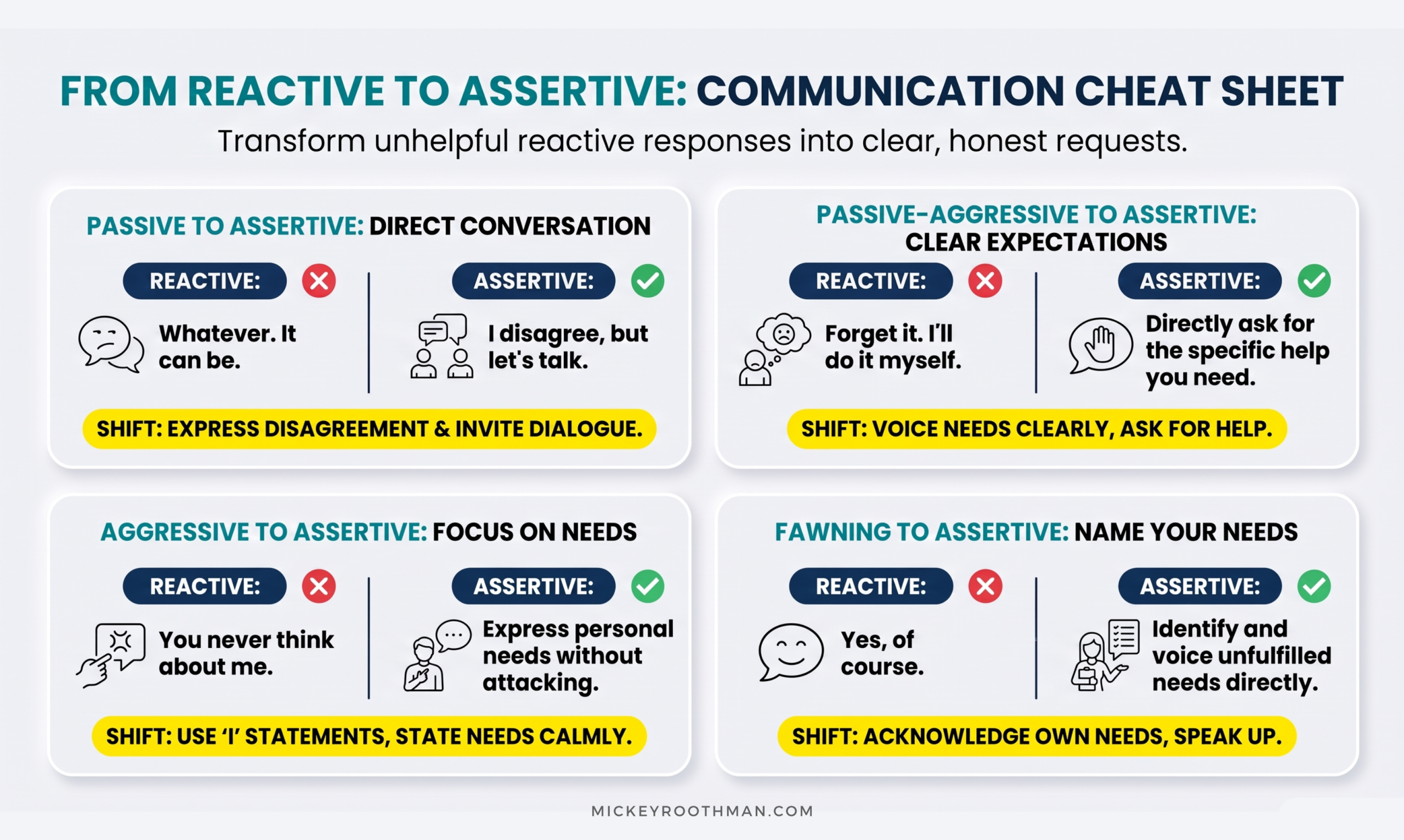
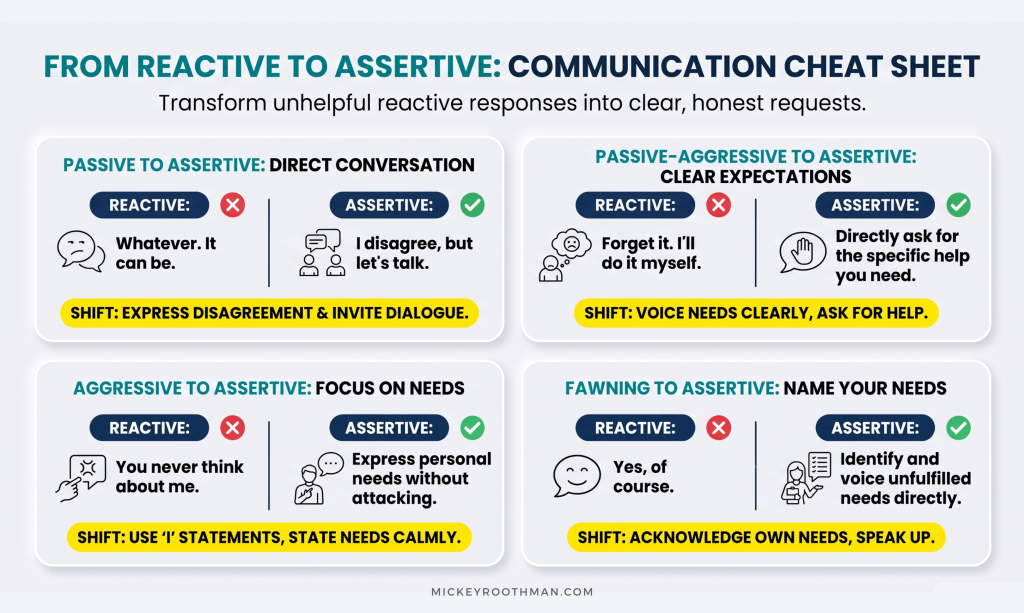
Real-World Cheat Sheet – Transforming Everyday Phrases

Theory and understanding a concept is one thing. Using it in everyday life (or remembering it for that matter in the moment when you need it) takes practice. But don’t worry – I’ve got you! Here is an easy to use Cheat Sheet to help you practice and transform your everyday phrases, in real time.

Cheat sheet showing how to transform passive-aggressive phrases into assertive 4 communication styles

(Download infographic here)


Key Takeaways & FAQ’s:

What is the main difference between passive-aggressive and assertive communication?

Passive-aggressive communication attempts to express anger indirectly while avoiding direct conflict. Assertive communication directly addresses needs and boundaries while treating the other person with respect, trading brief discomfort for long-term trust and clarity.

Can someone be both passive and aggressive?

Yes! Many people cycle between passive and aggressive styles. They swallow their feelings passively until their resentment reaches a boiling point, resulting in an aggressive blow-up, followed by guilt that pushes them right back into passivity.

How do I deal with a passive-aggressive colleague or partner?

Do not play into the guessing game. Address the non-verbal behavior calmly and directly: “You mentioned everything is fine, but I noticed your tone sounded frustrated. I’m open to hearing what’s on your mind so we can figure it out together.”


CONCLUSION: Say What You Mean – Mean What You Say

Communication is a muscle. You won’t master assertiveness overnight, especially if you’ve spent decades pleasing others or using aggression to feel safe.

Start small. Pick one low-stakes situation this week, like ordering food, declining a minor social invite, or asking for a clarification at work — and practice speaking your truth (always from a space of love) directly. You’ll quickly find that the brief discomfort of honesty is infinitely lighter to carry than the heavy weight of built-up resentment because you didn’t.

Thank you for taking the time to invest in your personal growth and self awareness. If you found this information valuable and you know someone that would get value from it too, please hit the forward or share button now. For more tools and resources you can listen and subscribe to my Breakthrough Podcast Show Here.


Read More

How To Incorporate CBT Principles In The Workplace

Cognitive Behavioral Therapy (CBT) has many benefits, not only for individuals but for teams and workplaces as a whole.

CBT in the workplace has many benefits and can enhance employee well-being by addressing stress, improving resilience, and fostering a positive mindset. It also promotes better problem-solving skills, effective communication, and helps manage work-related anxiety. Overall, CBT contributes to a healthier work environment and increased employee productivity.

Employees are people and people have habitual subconscious patterns in the way they think and react to situations they are facing on a daily basis. CBT in the workplace is imperative as it can contributes to a positive work culture, increased employee satisfaction, and improved overall mental health, leading to higher productivity and job performance.

Organizational Development Specialist, Coach and CBT Practitioner Mickey Roothman says:

By incorporating CBT principles, workplaces can create a more supportive and psychologically healthy environment, fostering the well-being and resilience of employees. Training sessions, workshops, and ongoing support can help reinforce these principles and contribute to a positive workplace culture and increased Psychological safety at work.

Implementing CBT in the workplace involves several steps:

1. Assessment: Conduct an initial assessment to identify areas where CBT can be beneficial, considering factors such as stress levels, communication challenges, and overall well-being.

2. Training Programs: Provide training programs, workshops and coaching on basic CBT principles for employees. This may include understanding cognitive distortions, recognizing negative thought patterns, and learning coping strategies.

3. Employee Support Services: Offer access to mental health support services, such as counseling or therapy, either through in-house resources or external partnerships.

4. Promote Awareness: Create awareness campaigns to reduce stigma around mental health. Encourage open conversations about well-being and emphasize the importance of seeking help when needed.

5. Leadership Involvement: Encourage leadership to lead by example in embracing CBT principles. This can include managers openly discussing stress management techniques or participating in training programs.

6. Provide Resources: Make resources available, such as self-help materials, apps, or online platforms that support CBT practices. Ensure employees know where to find and access these resources.

7. Integrate CBT into Policies: Consider integrating CBT principles into workplace policies, such as promoting a positive work environment, encouraging work-life balance, and addressing issues related to workplace stress.

8. Feedback Mechanisms: Establish feedback mechanisms to gauge the effectiveness of CBT initiatives. This can include surveys, focus groups, or individual feedback sessions to understand the impact on employee well-being.

9. Create a Supportive Culture: Foster a workplace culture that values mental health and well-being. This involves recognizing and appreciating employees’ efforts, providing constructive feedback, and creating a supportive environment for personal and professional development.

10. Regular Check-Ins: Schedule regular check-ins to discuss mental health and well-being, both individually and within teams. This helps identify ongoing challenges and allows for timely interventions.

Practical Application of CBT principles in the workplace involves integrating the following concepts:

1. Cognitive Restructuring:

Encourage Positive Thinking: Help employees identify and challenge negative thoughts, promoting a more positive and constructive mindset in the workplace.

2. Problem-Solving Skills:

Teach Solution-Focused Approaches: Equip employees with effective problem-solving techniques to address work-related challenges and enhance their ability to find solutions.

3. Behavioral Activation:

Set Realistic Goals: Assist employees in setting achievable goals, fostering a sense of accomplishment and motivation in their work tasks.

4. Stress Management:

Mindfulness Techniques: Introduce mindfulness and relaxation exercises to help employees manage stress and stay focused in high-pressure situations.

5. Communication Skills:

Address Cognitive Distortions in Communication: Train employees to recognize and modify distorted thought patterns that may affect their communication with colleagues, clients, or superiors.

6. Self-Monitoring:

Encourage Self-Reflection: Promote self-awareness and reflection, helping employees monitor their own thoughts, emotions, and behaviors to identify areas for improvement.

7. Graded Exposure:

Gradual Exposure to Challenges: Facilitate a gradual approach to facing workplace challenges, allowing employees to build confidence and resilience over time.

8. Time Management:

Break Down Tasks: Teach employees to break down larger tasks into smaller, more manageable components, promoting a sense of control and reducing feelings of being overwhelmed.

9. Social Skills:

Role-Playing Scenarios: Conduct role-playing exercises to enhance interpersonal skills, enabling employees to navigate social interactions more effectively.

10. Positive Reinforcement:

Recognition and Reward: Implement systems for recognizing and rewarding positive behaviors and achievements, reinforcing a culture of positivity and accomplishment.

Get Professional Help:

Great leaders know that they don’t need to know how to do everything, or spread their time too thin by trying to do things or figure it out themselves.

Don’t deprive your organization or your employees from this essential tool, by procrastinating on incorporating CBT in your organization or team due to a lack of time or knowledge. CBT is a very specialized field, so get specialized professional help from an Organizational Development Specialist or a CBT Practitioner who specializes in CBT in the workplace.

If there’s one thing that is essential for organizations to implement in the workplace in 2024, its CBT. Don’t wait. Start today.

Need professional help? Book a consultation with Organizational Development Specialist, Coach and CBT Practitioner Mickey Roothman click here now

Read More

Cognitive Behavioral Therapy (CBT) is essential in the modern workplace.

What is Cognitive Behavioral Therapy (CBT)?

CBT stands for Cognitive Behavioral Therapy. It’s a widely used therapeutic approach that helps individuals identify and change negative thought patterns and behaviors, aiming to improve mental health conditions such as anxiety and depression. We live in a fast-paced ever changing world which is why CBT has become an essential in the work place. Its a crucial part of cultivating a culture of psychological safety and wellbeing.

How does CBT work?

CBT works by helping individuals recognize and change negative thought patterns and behaviors. Therapists work collaboratively with clients to identify and challenge distorted thinking, replacing it with more balanced and constructive thoughts. The goal is to modify behaviors associated with negative emotions, promoting healthier coping mechanisms and improving overall mental well-being.

Why should you implement and integrate CBT in the workplace?

Organizational Development Specialist, Coach and CBT Practitioner Mickey Roothman says:

Employees are people and people have habitual subconscious patterns in the way they think and react to situations they are facing on a daily basis. CBT in the workplace is imperative as it can contributes to a positive work culture, increased employee satisfaction, and improved overall mental health, leading to higher productivity and job performance.

CBT in the workplace can enhance employee well-being by addressing stress, improving resilience, and fostering a positive mindset. It also promotes better problem-solving skills, effective communication, and helps manage work-related anxiety. Overall, CBT contributes to a healthier work environment and increased employee productivity.

Benefits of CBT in the Workplace:

  • Stress Reduction: CBT equips employees with tools to manage stress, helping them navigate work pressures more effectively.
  • Improved Problem-Solving: By addressing cognitive distortions, CBT enhances logical thinking, aiding employees in approaching challenges with a solution-oriented mindset.
  • Enhanced Resilience: CBT fosters resilience by teaching coping mechanisms, enabling employees to bounce back from setbacks and adapt to changes in the workplace.
  • Positive Mindset: It promotes a positive outlook by challenging negative thought patterns, leading to improved morale and a more optimistic workplace atmosphere.
  • Effective Communication: CBT can improve interpersonal skills, enhancing communication among team members and reducing workplace conflicts.
  • Increased Productivity: Employees with better mental health, achieved through CBT, tend to be more focused, engaged, and productive in their work.
  • Better Work-Life Balance: CBT assists individuals in establishing boundaries and managing work-related stress, contributing to a healthier work-life balance.
  • Reduced Absenteeism: Improved mental health through CBT may lead to decreased absenteeism as employees are better equipped to handle work-related challenges.
  • Enhanced Team Dynamics: CBT can strengthen team relationships by promoting empathy and understanding, creating a more supportive and collaborative work environment.
  • Prevention of Burnout: By addressing factors contributing to burnout, CBT helps employees maintain a sustainable level of engagement and satisfaction in their roles.

Practical ways CBT positively contributes to the workplace:

1. Time Management Improvement: CBT techniques can assist employees in identifying and addressing time-wasting habits, leading to better time management and increased productivity.

2. Conflict Resolution Skills: Through CBT, employees can develop effective communication and conflict resolution skills, reducing workplace tensions and promoting a harmonious environment.

3. Meeting Anxiety Reduction: CBT can help individuals manage anxiety related to meetings or presentations, ensuring that employees can contribute confidently and express their ideas more effectively.

4. Workload Stress Management: CBT equips employees with tools to manage overwhelming workloads by breaking tasks into manageable parts and developing realistic strategies for completion.

5. Feedback Processing: CBT can aid in processing feedback constructively, helping employees view feedback as an opportunity for growth rather than a source of stress.

6. Adaptation to Change: In times of organizational change, CBT can assist employees in adapting to new circumstances, fostering a more resilient workforce.

7. Remote Work Adjustment: With the rise of remote work, CBT can help employees navigate the challenges associated with isolation, time management, and maintaining work-life balance.

8. Customer Service Enhancement: CBT techniques can be applied to improve customer service by helping employees manage stress in high-pressure customer interactions and maintain a positive attitude.

9. Team Collaboration: CBT fosters a mindset of collaboration and teamwork, reducing interpersonal conflicts and enhancing overall team dynamics.

10. Leadership Development: CBT can benefit leaders by improving emotional intelligence, decision-making, and conflict resolution skills, contributing to more effective and empathetic leadership.

By incorporating CBT principles, workplaces can create a more supportive and psychologically healthy environment, fostering the well-being and resilience of employees. Training sessions, workshops, and ongoing support can help reinforce these principles and contribute to a positive workplace culture.

Remember, the successful implementation of CBT in the workplace requires commitment from leadership, ongoing communication, and a genuine effort to create a supportive and mentally healthy work environment.

Need help incorporating CBT Principles into your workplace or team dynamic? Get in touch and book a consult with me here.

If you enjoyed this article you may also like to read How To Integrate, Incorporate and Implement CBT Principles In The Workplace

Read More

Why We Need Contrast To Be, Do & Have Better In Life

Why we need contrast and nothing is difficult or wrong

If you’re ready to be, do & have better in life but it feels like you’re experiencing the opposite of what you want right now or don’t understand the contrast we sometimes face, then keep reading.

  Its 06:00 on a beautiful Autumn morning.   I look outside the window in awe of the majestic sunrise over a clear sky, birds merrily chirping to greet another day.   My eyes catch a glimpse of my pooches still fast asleep next to me and my heart and face light up with love and gratitude for these two little fur balls.   “How blissful they look” I think.  “Just the perfect picture and epitome of unconditional Love and just being.”   “Yeah its probably because every day is a good day for them. They don’t experience ups, downs and stresses of life like we do as humans” my ego mind chimes in with the conversation.   But very quickly my consciousness interrupts the egoic thoughts asking: “Why can’t every day just be great? Why do we have amazing days and then not so amazing days? I mean life would just be great if we never had to do anything we don’t enjoy or have those harder conversations in life, wouldn’t it? Would it, really?”   My mind began to wonder, searching for the answers to these loaded questions I just posed to it.   It began to take me back to memories of days that were just all rainbows, glitter, unicorns and feel good warm and fuzzy stuff and experiences.   Then it took me back to a few memories of days that I’d rather forget where it felt like my heart was bleeding to death and I thought I’d never survive.   “No wonder most people prefer to avoid, run from and bury the more difficult experiences and emotions rather than to face them” my ego tries to interrupt the conversation again.   And then it suddenly hit me!   We live in a universe full of contrast!
  • Day and night.
  • Summer and Winter.
  • Male and female.
  • Light and dark.
  But why does contrast even exist? I mean wouldn’t it just be easier and a heck of a lot more amazing if everything was always constant, the way we like it and just all moonshine and roses all of the time?   Truth is no it wouldn’t be. Aside from the fact that we’d actually get totally bored with life (I mean just imagine sitting through a movie where everything is just perfect the whole way through with no suspense, no plot, no unfolding, no twists and turns), the contrast actually is intended to serve our highest good. That is the core purpose of its existence.  

We actually need it.

Without the contrast we could never grow, expand and evolve into the highest version of ourselves and what our soul’s pursuit and purpose on this earth really is.   Do I prefer the great days? HECK YES! I’m sure most of us do. But if we didn’t have the “not so great ones” then how would we even know what the good ones feel like?   If darkness didn’t exist, there would have been no such thing as or even a need for light.   The fact that Thomas Edison even thought of inventing the light bulb was because darkness existed which created a need for it, right?   Without contrast we would really all just be robots existing with no purpose, no desires, no experiences, no evolution and frankly no emotions or a need for them.   There would be no innovation or technology either.   Think about it for a second. The reason you know what happiness feels like is because you’ve experienced sadness. The reason you know how you like your coffee is because you’ve experienced more than one brand, more than one way of drinking it, right?   Our need for things to be done simpler, better, faster and different has also driven innovation and technology as we know it today and it is all birthed through a desire and a need for things to be different which we wouldn’t have had if we didn’t experience the opposite of it first.   Without the one, the other simply cannot and would not exist.   Sure, we would all rather have perfect relationships and never have to have the hard conversations. We would all rather experience happiness than sadness, ease rather than difficulty. But it is really our labeling and judgement of things (our perception of them) that makes them appear good or bad to us.   We label and judge things as good or bad, easy or difficult, how it should or shouldn’t be based on societal norms and beliefs that have been handed to us, when in fact it all is exactly as it should be.   This is exactly why it also doesn’t serve us when all of us are trying to change who we are or be or look the way society has labelled as acceptable, perfect, successful, happy, good, bad, pretty or whatever else. We need our unique differences to serve the evolution and highest good for us all and of this planet that we call home for now too.  

What if I told you that it is your desire to evolve that drew the opposite into your experience in the first place?

    Think about it for a second. By experiencing the opposite of what you want you identify and learn what it is you do want. That’s GROWTH. That’s EXPANSION. That’s EVOLUTION!   And its never ending too. The type of partner you’re attracted to has vastly changed over the years as you experienced and refined what you do want in a partner by dating people who showed you what you didn’t want, right?   Life is always going to present us with contrast. How it serves us lies in how we choose to see it.   When we see it as “This shouldn’t be happening. This isn’t how things should be” we have a not so good experience.   But when we see it as “Everything is as it should be and it is always happening for me to serve my highest good” we cruise blissfully through what others may perceive as “bad days” or “bad times” with our inner peace and happiness in tact.   For me that is really what free will is.   If our story was already written before we were born, it really just comes down to how we choose to experience it. We can either experience it from a place of “God promised that all things He makes work together for my good. So this too is for my good” while waiting for the unfolding and the next chapter. Or we can experience it from a place of “God has lost control and this shouldn’t be happening and is never going to get better.”   Either way how you end up experiencing that thing will reflect how you choose to see it.   We only really have 2 choices in any experience life throws at us. To perceive and experience things through the eyes of Love, or through the eyes of fear.   And although contrast is what helps us to learn, grow, heal, evolve and expand, we can always choose to learn through love and not through difficulty or fear.  

DO THIS NEXT TIME YOU THINK YOU’RE HAVING A “NOT SO GOOD” EXPERIENCE:

When a “problem” situation pops up. Don’t panic and don’t go into those old familiar thought patterns of “Why is this happening? How am I gong to solve this? What am I going to do?”.   Instead take a moment to stop, breath deeply a couple of times, silence those thoughts and say this out loud to yourself: All is well. Everything is working out for my highest good. Out of this experience only good will come. I am safe.   Take note of firstly how much better and calmer you feel and then be expectant and on the look out for the universe to present the solution or to you or dissolve the “problem” for you, as it was always designed and intended to do.   We don’t ever really need to fix “problems”.  We only need to fix our thinking and perspective about it.   That in itself is already growth, evolution & expansion that serves your highest good and the highest good of all others involved.  

YOU MIGHT ALSO LIKE:

A Powerful Prayer When You Struggle To Let Go & Let God The Roadmap To Finding Inner Peace & Wholeness 5 Crucial Self Care Practices For Inner Peace & Wellness During Turbulent Times Like The Covid 19 Lockdown
Read More

EMOTIONAL DETOX: 7 Pivotal Steps To Emotional Freedom

Wheel of Emotions So its one of “those” days where everything that could possibly go wrong; does, and your emotions are off the charts, in fact your emotional well being seems severely under attack and at risk. You wake up only to see that its 06:30 AM and that’s the time you’re already supposed to be leaving for work. Your alarm clock didn’t go off for some inexplicable reason and no matter what you do, you’re going to be late! You hustle to shove yourself into the outfit you luckily laid out for work already last night, but as you grab your coffee to get one sip in on the way out, you spill it all over your brand new, crisp white Chanel shirt. So you rush to change only to find that your back-up preference is in the washing basket and your washing day is only tomorrow.. You eventually make it to the car with no further delays only to realize that you forgot to fill up your tank last night and the petrol light seems like its deliberately trying to be snarky flashing the words “EMPTY” in big red letters at you! You finally make it to the office and it appears that all hell had broken loose in the mere 10 minutes that you were late. To top it all off, the boss is in a bad mood and glaring at you (you think its probably because you’re late) and he piles yet another crisis that is on deadline onto you. At this point the “drama queen” inside your head revs it up a gear, kick into overdrive and she’s like: “He’s probably testing me to see if I will manage. He’s just setting me up to fail.  He never liked me anyway. I bet he is just looking for a reason to fire me and my being late just added another bullet to his arsenal. Oh my gosh how will I find work again. The job market is so over-saturated as it is. I’m going to starve and end up living as a bum on the street. Why didn’t I just take my phone in last time it did that? Oh yes it was because I had to work late to finish that project. That my boss doesn’t remember. He doesn’t even see the value I bring to the team and all of the extra things I do. Why the heck do I do them anyway? They don’t appreciate me. No one does. Its because I’m not good enough. Just like my ex. Nothing is ever good enough. Maybe I should just resign before he fires me” – EASY THERE GIRL! STOP & BREATHE! We’ve all had a day, at times a week and some are even convinced a life like this, right? Okay that may have been a little bit over dramatized but you get the gist. And it serves the point I’m getting to. When you read that, how did it make you feel? A little anxious perhaps? Did your heart start racing or your stomach turn into a knot? Changes are that it absolutely did. That wasn’t even happening for real and it wasn’t even happening to YOU, yet your body reacted to it physically anyway and here’s why.
  • The mind doesn’t know the difference between fantasy and reality. So whatever you’re thinking it thinks is really happening. I wrote that in the first person and you read it that way too, so your mind did 2 things there. It perceived is as something you are really thinking and thus experiencing and it reacted accordingly by letting you feel it as emotions and physical manifestations in your body.
  • Despite most people believing that their emotions cause their thoughts, its actually the other way around. Our thoughts cause our emotions. You read it (thus thought it) and pesto, you felt it right? Not convinced? Think of a person or situation that makes you anxious. Focus on your body for a second and feel how and where you can feel that anxiety in your body. Whatever you thought about isn’t even happening at the moment yet you were able to conjure up those emotions physically in the present and physically react to it anyway just because you thought about it.
From a young age, most of us are taught that emotions are a bad thing, not acceptable, shameful and even a sign of weakness. But the truth is its really our power! Our emotions are our GPS and KPI’s to what we can expect to experience showing up in our reality soon. Emotional Healing Detox   Let me explain. So you already know that our thoughts cause our emotions. But what are emotions? Just like thoughts, emotions are vibrational energy. And Science and in Quantum circles it has already been proven that energy attracts the same energy to itself. So whatever vibrational energy you are sending out through your emotions is really what you’re attracting more of to yourself then. Right about now you may also be having a little “AHA’ moment going on inside of you as to why it is that when one bad thing happens it can feel like it caused a snowball effect causing an avalanche of sh*t bombs rolling your way. But, this doesn’t have to happen. See if you re-calibrated your energy after the first shitty thing happened, you wouldn’t have attracted more drama into your experience. Re-calibrate your what now? Well basically if you chose a better thinking thought in that moment like: “Well, stuff happens. I couldn’t control the alarm clock not going off. I’m never late and I’m a hard worker so I’m sure my boss will understand. Everything happens for a reason and I am thankful for whatever this experience was here to teach me or protect me from” , none of that other stuff would have happened. You would have pivoted from a low negative vibrational energy (thoughts and feelings) to a high vibrational energy in an instant and that would have been the end of it. The rest of your day would have gone a lot smoother and you would have had a lot more joy and inner peace too. So what we attract then really starts with our thoughts. But here’s the big whopper! We think around 80 000 thoughts a day and only 5% of those thoughts are thoughts we are consciously aware of. The other 95% are subconscious thought patterns based on our upbringing, past experiences and beliefs that are running on auto-pilot. Hang ten now, don’t get discouraged just yet! The title of this blog said that this was about showing you how to do it and I always deliver on my promises. Okay, so if we we’re not even aware of our thoughts like 95% of the time and they’re running on auto pilot, how do we then know when we are thinking a low vibrational thought that will attract more low vibrational experiences to us? QUE DRUM ROLE PLEASE ….. Through our EMOTIONS! Like I said in the beginning, our emotions are really our GPS for what we are busy attracting to ourselves and creating in our lives. And lets face it. It’s a heck of a lot easier to be aware of how you feel than it is to try and manage 80 000 thoughts a day of which 95% are subconsciously on autopilot. We usually know when we don’t feel well emotionally because our body reacts to it physically in manifestations like stomach knots, headaches, neck spasms, ground down teeth, chest pains and so much more. The important one to mention here is that it may manifest as debilitating and even serious physical illnesses. Emotions are energy but they also cause chemicals to form in our body. This is really the body’s way of trying to protect us, our built in protection and self preservation mechanism. But these chemicals were meant to protect us for short term threats we experience in our environment and they were never meant to be present for extended periods of time. So when we are not aware of low vibrational thoughts causing low vibrational feelings and manifesting as toxins in our body that aren’t dealt with over an extended period of time, our body will eventually warn us that something needs to get “processed” and worked on that is causing it to malfunction in the form of illness. if we can learn to become aware of our emotions and to process them, we can nip it in the bud straight away and not wait for more bad experiences to show up or for physical illness to set in to tell us that we are headed for disaster.

MY 2 FAVORITE PRACTICAL TIPS TO LIVE AWARE OF YOUR EMOTIONS:

  • Set hourly reminders on your phone that just says “How do I feel?” – Stuff happens throughout our day and this way we are prompted to become aware of how we feel every hour, and then either process it or at the very least pivot by choosing a better thinking thought and better feeling emotion in that moment, stopping the low vibrational thoughts and energies from gaining more momentum.
  • At the end of the day before you go to sleep or when you’re soaking in a bath, reflect on your day’s experiences. Become aware of how they made you feel, what you thought about it and how you acted and reacted to it. This way you choose to pivot and stop those low vibrational thoughts, feelings, experiences and frankly the story you told yourself about it in its tracks at least once a day and you don’t carry it into the next day with you which stops its from gaining momentum.
PS: If you’re like me and you struggle to identify what emotion you are feeling at times, have no fear. Use the following Wheel Of Emotions Chart to help you to hit the nail on the head. Wheel Of Feelings Now you may be thinking, “what about all the other times I didn’t do this because I didn’t know about it yet? “Fact is there may be some old trapped emotions in your body that you need to release. Its time for you to do an Emotional Detox! Clean the slate and pivot! You’ll experience tremendous emotional freedom and as a bonus your energy levels and health will increase as well. Overall you’ll just be feeling GREAT and attracting more of the experiences you DO want into your life as a result. Like everything in life it takes some commitment and action on your part, but I promise you it is easy to do and so damn worth it!

HERE’S MY 7 PIVOTAL STEPS TO EMOTIONAL FREEDOM:

You can do this exercise as an emotional detox now to process specific events and experiences, but its also a great daily practice to incorporate when you become aware of how you’re feelings through your hourly phone reminders, or once a day when you’re reflecting on the day that has passed. These 7 steps will help you to process and release emotions straight away with a lot more ease as you bring them to conscious awareness.

NEED A LITTLE EXTRA SUPPORT?

Check out the blog on The Roadmap To Finding Wholeness & Inner Peace Check out the blog on 5 Steps To Lasting Happiness That No One’s Told You About Dive a little deeper into a meaningful life with my Ultimate Life Transformation Program Listen to this Podcast Episode of Breakthrough on 5 Steps To Getting Your Breakthrough  Connect with me on Facebook Connect with me on Instagram Connect with me on Linkedin

DID YOU FIND THIS HELPFUL?

SHARE THE LOVE AND SHARE IT WITH A FRIEND WHO NEEDS IT TOO.

Read More

The Roadmap To Finding Wholeness & Inner Peace

  The Roadmap to wholeness and inner peace   Wholeness is something we all desire. Yes, even that person you look up to or secretly envy whose life just looks amazing on social media.   The dictionary describes wholeness as: 1)  the state of forming a complete and harmonious whole; unity 2)  the state of being unbroken or undamaged.   But what is wholeness really?   After almost 10 000 hours of one on one coaching and mentoring with clients, I would say that what represents a state of wholeness to each of us is different. For some wholeness is represented by inner peace, direction & purpose and for others it is represented by their external circumstances and achievements.   The Roadmap To Wholeness and Inner Peace   One of my favorite quotes by the Sufi Poet Rumi is: “Everything in the universe is within you. Ask all from yourself.” Whatever represents a state of wholeness to you personally there is only one path to achieving it ….. turning inward! Wholeness is an internal state.  It can only be achieved through our own actions, choices, thoughts & beliefs and never by external factors outside of our control.   Further below n this blog I share the 7 Principles to achieving tangible, lasting wholeness that I learned from the poet and teacher Rumi. I modified them slightly based on my own experiences and research and have integrated these principles with great results and success into my own life. The results I’ve seen from implementing these 7 principles on a daily basis in my own life as well as the lives of my coaching clients has been consistent and nothing short of miraculous!


Follow these 7 simple principles and you are guaranteed to achieve wholeness and inner peace

Find Wholeness and inner peace Carl Jung Quote  
  1. Remove Anger: 
Anger doesn’t’ just feel awful, it also creates toxins in our body that make us ill. But most importantly, it is a very low vibrational energetic frequency to vibrate at.  The root of anger is really fear which is an even lower vibrational energy to vibrate at. We attract things into our lives of the same vibrational frequency that we’re vibrating at, so unless you want more things to be angry or fearful about, let go of anger and fear. The mind is very powerful and it doesn’t’ know the difference between fantasy and reality. What you think about you’ll feel even if it isn’t really happening in the present moment. So stop playing that movie of what happened over and over again in your head. Decide to let it go. This brings us to the next principle …..  
  1. Forgive:
It’s been scientifically proven that unforgiveness can cause life threatening illnesses. Forgiveness doesn’t mean that you condone what the other person did. It just means that you love yourself enough to not poison your own body and sabotage your own dreams.  Suffering is truly optional and we can choose to end our own suffering at any time by choosing to forgive. Set yourself free today – forgiveness is the key. (If you need some help with letting go and letting God click here for a powerful prayer).  
  1. Release All Judgement:
This was a hard one for me to overcome. Not just judgement of others but of myself too. Judgement only causes us more suffering. It is derived from us clinging to the dualistic, fixed patterns of believing that things are right or wrong and really stem from our own beliefs about whether we are loved or unloved, successful or unsuccessful, deserving or undeserving, abundant or depleted, advantaged or disadvantaged, important or unimportant … you get the gist right? We were never meant to monitor anyone else’s journeys but only to focus on our own journey of evolving and becoming the highest possible version of ourselves.  And every single person is on that journey too. We are all just mirrors to one another of things we desire and need to heal within ourselves in order to reach our own highest potential and we cannot do it when we have judgement towards ourselves or others.  
  1. Have Compassion:
We are all on a journey to heal, grow, learn and evolve and we do so through experiences and by learning through contrast. We cannot know what we do want or who we want to be without experiencing what we don’t want and who we don’t want to be.  Every single human on this earth is on their own journey to discovering their highest potential, including you. We are all learning, we are all growing, we are all evolving, we all have fractured experiences, “issues” and “stuff”. And most importantly, we all did the best we could with whatever we knew at any given moment of our lives. We can only choose to learn, grow, heal and evolve and to do better each time. So have compassion with yourself and with others. We are all on the same journey. Practicing compassion will help you to release anger and forgive too. Choose non-judgement of yourself and others and choose to have compassion for yourself and for them instead.  
  1. Stay Humble:
No matter what we achieve or how much we evolve, grow, heal and become better versions of ourselves, humility should always remain. So many people become judgmental of others when they begin to evolve and grow, but the truth is this is an ego state of mind. Our ego is what makes us believe we are separate from one another. That we are in competition with each other. That some are superior and others inferior to one another. But the truth is we are all the same. The same essence just in different bodies and on different journeys while we are here on earth. And although we are powerful spiritual beings, we are not doing it alone. There is a Higher Power at work in us, through us and with us without which we cannot achieve anything anyway. So remember to stay humble. Practicing the principles of releasing all judgement of others and yourself and having compassion as mentioned in the previous points will help you to stay humble on your journey as well.  
  1. Be Content:
Our egoic mind tells us when things appear in our experience that we perceive as “not good” or “undesirable”, that what is busy happening is “wrong” and “not as it should be”. The egoic mind feeds off of drama, difficulty and suffering under the false pretense of protecting us.  Truth is that everything is always happening for us and never to us. As I mentioned in one of the previous points, we learn through experiences and through contrast. Another way to describe being content is gratitude or appreciation. It is choosing to see whatever is going on as being here to serve us on our journey to grow, heal, evolve and become the highest possible version of ourselves. Have gratitude and appreciation for whatever “is” as being a servant, teacher, guide and catalyst to the best possible version of you. When we resist “what is” in any given moment we suffer. Acceptance, contentment, gratitude, appreciation and non-resistance of what we deem as unpleasurable or something we are adverse to ends our suffering and allows these events and experiences in our lives to serve us. Total acceptance and gratitude for “what is” goes beyond what we think “should be” or “ought to be”. It is a knowing that from our limited ego perspective we cannot fully see the big picture and that all there is, is the present moment and it is perfect right now exactly as it is.  
  1. Be Generous:
This principle doesn’t need much explanation.  We all know that being generous feels really good to us as humans and makes others feel amazing too. Generosity is often perceived as being generous materially, but generosity spans much further than just being generous financially or materially. We need to be generous in the giving of our time, our compassion, our attention, our love, our appreciation of others and ourselves and everything else that we have to offer as an individual and as part of the collective here on earth.  

PRACTICAL DAILY INTEGRATION & IMPLEMENTATION OF THESE PRINCIPLES:

These principles are usually things we know and strive to be. But life happens and we find ourselves yanked out of our desire to live this way without even realizing it at times. Here are a few practical ways that has helped me to implement and integrate these principles into my life as a way of life to experience optimal results:
  • Set hourly reminders for yourself on your phone. Make each of these principles one of your hourly reminders and when it goes off, either do something practical in that moment to practice it, or spend 5 minutes in quiet meditation pondering it and visualizing yourself being and living it and how it impacts your life and the lives of those you interact with
  • At the end of each day, reflect on the day that has passed and write down how often you did and didn’t implement each of these principles in your experiences, thoughts, interactions and actions throughout the day. Remember to practice compassion and non judgement for yourself and others in this process. If you identify an experience where you didn’t practice a principle, simply acknowledge it, thank it for being your teacher and healer, write down how you can do it better next time or would like to handle it next time and then choose to do better tomorrow.

YOU MIGHT ALSO LIKE THIS:

Read More

“You will reap what you sow” – Its Not About The Deeds You Do.


For the better part of my life I didn’t really believe that I was reaping what I sowed.

I believed it was true for everyone but me.

I believed God loved everyone but me.

I believed that His promises were true for everyone else, just not for me.

“I guess my purpose is to help others to live a great life and never experience it myself” is a thought that crossed my mind often.


My entire experience for the first 3 decades of my life looked a little something like this:

  • I always did and gave more than what was expected of me for others – but no one ever delivered on their promises to me.
  • I was always there for everyone – but when I needed someone those same people would avoid me and I’d have no one who was there for me.
  • I consciously treated others kindly, lovingly and respectfully – but I was always treated disrespectfully, worthlessly and unkind.
  • I did things honestly and with integrity – but I was always being done in, treated unfairly and lied to.
  • I was a loyal friend – but I was discarded and backstabbed the moment I wasn’t of use to someone anymore.
  • I was giving – but I was financially in distress most of the time.
  • I helped people without them even asking for it – but even if I did ask for help no one ever gave it to me.
  • I would drop everything to be there for others when they were going through something – but everyone else was always too wrapped up in their own lives to ever be there for me when I needed it most.
  • In everything I did I tried to be a good human – but humans were never good to me in return.


There are thousands more examples of this that I can offer right now, but I’m sure you get the gist as to exactly why I didn’t believe that God’s promise of reaping what you sow applied to me.

I had more than enough evidence of the opposite of that playing out in my life and although I never stopped believing that we reap what we sow, I just began to believe that for some reason it wasn’t true for me too, which of course lead to me feeling like I was just God’s servant and servants although they do the hard work are never the ones that get to enjoy the fruits of it, right?

I was sitting in a church one evening, a place that we perceived as being filled with believers that should be reaping and experiencing amazing lives due to their choice to live (sow) the way that God “expects us to”.

The pastor began to run down the usual list of “issues” that we as people might have like finances, relationships and health and he then proceeded to ask the congregation to put up their hands if they were having a hard time and needed prayer for any of these.

Everyone’s eyes closed at this point of course so no one would “judge” anyone by seeing who has what problem.

But in that moment I heard a voice inside me say: “Open your eyes and look up.”

What my eyes saw was shocking to me. Out of a congregation of about 500 people,  people who were believers, almost 98% of their hands were up.

Tears started streaming down my face uncontrollably (they weren’t mine and today I believe that is the closest I ever came to experiencing the grieving of the Holy Spirit) and I just shook my head, closed my eyes and silently said to God: “Your bride is broken. But I don’t think it is You that is a liar or not keeping your promises. So what is it that we are missing? Please show me.”

That prayer turned out to be the biggest catalyst to my spiritual awakening, growth and enlightenment journey that started about 5 years ago.

God took me on a miraculous journey where He began showing me how He made the human body, how everything in this universe works and supports all of us all of the time. How we’ve disconnected from who we really are which is not human beings having a spiritual experience but powerful spiritual beings having a human experience.

He showed me how some of the beliefs that were handed to us and passed down from generation to generation was holding us back from really knowing Him and really having the amazing lives that He intended for us all to have while we are here on earth.

One of the things He shared with me on my journey was that His principle of reaping what you sow was never about the deeds or about what we do.

You see, everything in this universe is energy, including us. He made it that way. Even our thoughts (whether conscious or unconscious), our emotions and our intentions are energy.

Science has already proven that energy attracts to itself the same kind of energy and when enough of that same energy comes together it becomes matter (physical form).

So whatever good deed we are doing, if the energy behind it (the thought, the belief, the intention, the emotion) behind it isn’t positive, we can’t and won’t attract good and positive energy back to us.

Looking back at my experiences before I was awakened to this truth, I now see exactly why no matter what I did, no matter how good it was, the energy behind it was thoughts, feelings and emotions of not being worthy, not being deserving, some resentment and doing what I though was the right and acceptable thing to do instead of what I really wanted to do or felt called to do in a given moment.

Today I know that no matter what good deeds I did, the law of energy was attracting back to me the energy of unworthiness, undeservingness and not good enoughness that I was vibrating at and energetically thinking, believing and experiencing internally beneath it all (most of the time very unaware of it and subconsciously).

And if I’m totally honest with myself, my intention behind the good deeds I did probably wasn’t always backed with faith, love and goodness but perhaps some kind of hope that if I kept doing good, I would eventually get the same back or that I would please God enough that good things would begin to flow my way too.

I had to get out of the “system” of all of the beliefs that were handed to me from a young age, to become consciously aware of them in order for me to really begin a true relationship with God where He could show me Himself exactly who He really is and how things really work. I needed take an honest inventory of and question the beliefs that were handed to me for Him to be able to expand my mind to see His truth.

Sadly most religions teach us that if we just continue to do the right things God (or whatever Higher Power resonates with you) will be pleased with us and we’ll receive good things back. But the reason why that is busy crumbling is people are not experiencing that and its because it was never about the doing. It was always all about the energy.

So many believers keep doing right but never experiencing the reaping of it and subconsciously they’re beginning to resent that, feel unworthy and undeserving of good things and even question God. And because that energy is what is underlying behind their good deeds, they never experience good things coming back to them and remain in that cycle.

I’m not saying our deeds don’t matter, they absolutely do. I’m just saying that our deeds mean nothing if we don’t pay attention and become consciously aware of the energy (thoughts, beliefs, feelings and intentions) underlying and behind them.

For example, if you are doing good because your belief is that then good things will come back to you, the energy behind it is actually manipulation if you think about it. You’re doing it with a desired result in return in mind instead of doing it from a place of pure love and because you felt lead to do it from a space of love and connection to the Sprit within you.


If you haven’t been experiencing that you truly reap the good that you sow…

I want to challenge you to take an honest inventory of what the real energy has been behind your deeds up to now. Ask yourself what were the real thoughts, beliefs, feelings and intentions (energy) that they were backed with.

I urge you to allow yourself to begin to open your mind and to see that it is not about the deed itself but about the energy it is backed by and I guarantee you will experience the energy you put out returning back to you tenfold every single time.

This truth and realization changed my life and my entire experience, and my hope is that it will do the same for you too.

YOU MIGHT ALSO LIKE THIS:

Read More

5 Steps To Lasting Happiness (that nobody’s telling you about)

5 steps to lasting happiness blog by Mickey Roothman Coach, Speaker & Author

Happiness seems so hard to come by and even harder to hold onto, right?

The other day I was talking to one of my clients about why we struggle to hold onto the “new & improved me” and to remain positive and hold onto our happiness once we’ve chosen a better life. It got me thinking about my own journey of see-sawing up and down from the highest of highs to the lowest of lows in literally seconds at times. Now before I had gone on my self awareness and spiritual awakening journey to understand why we are who we are and do what we do, this was a common occurrence, but it didn’t make sense why it was STILL happening now that I knew better and had made the conscious choice to be happier and implemented the daily practices to back it (like meditation, daily reflection, questioning my thoughts, etc.) Even the apostle Paul wondered why he still did the things he didn’t want to do even after he chose to turn his life around.
”I do not understand what I do. For what I want to do I do not do, but what I hate I do. 16 And if I do what I do not want to do, I agree that the law is good. 17 As it is, it is no longer I myself who do it, but it is sin living in me. 18 For I know that good itself does not dwell in me, that is, in my sinful nature.[a] For I have the desire to do what is good, but I cannot carry it out. 19 For I do not do the good I want to do, but the evil I do not want to do—this I keep on doing. 20 Now if I do what I do not want to do, it is no longer I who do it, but it is sin living in me that does it”. – Romans 7:5-20
Have you ever notices that you can be on such a huge high, so positive and ready to be a nice human after watching an inspirational Youtube video or reading a powerful motivational quote, until …. something shitty happens in your day or your life that in one foul swoop just seems to knock you back down to a low vibe, negativity or lashing out at someone. See here’s the thing … We are “pre-programmed” as humans to resist happiness & feeling good. Yes, you heard me right. Our unconscious default setting is that we have to struggle, difficulty, and to feel guilty about being TOO successful, TOO happy, TOO wealthy. And when we finally have those things, we begin to feel guilty for having them. We go into fear about losing them and begin to wait for the other shoe to drop and for it to be ripped away from us at any second. But why? Because we’ve been sub-consciously programmed from a young age that good things don’t come easy and that they don’t last.

Before we dive into how to KEEP our happiness, lets look out how to find it first.

The route to finding real happiness can be described in one word: SELF-AWARENESS. See until we become aware of our own emotions, habits, beliefs, thoughts, actions, reactions and so on, we cannot really be happy. These are the very things that caused us not to be happy in the first place and until we become aware of them, we cannot begin to change them to change the outcome. Looking outside of ourselves for happiness just makes us fearful on an unconscious level anyway because we sub-consciously know that other people and external factors are the things we don’t have any control over. And as humans we fear what we can’t control (like other people for example). The reality is that the only thing we do have control over is OURSELVES. This is why finding happiness can only start by taking your focus off of what’s going on outside of you and becoming self-aware of whats going on within YOU!

So, once you’ve found real happiness, how do you hold onto it?

It took me several years of doing everything I knew to do to hold onto the new, positive and conscious living me to figure out what REALLY brings about lasting, tangible results when transforming our lives. Through my own personal life transformation journey from being broke, victimized, undervalued, sad, angry, stressed, anxious, lost, alone and directionless to consistently being happy, free, certain, clear, supported, successful, healthy, joyful and valued and over 10 000 hours of 1:1 coaching with my clients to identify exactly WHAT brings lasting change and transformation. What I identified was that we need to address the areas of our life that we want to transform on each of these 5 key levels: 1) Emotional 2) Behavioral 3) Mindset 4) Spiritual 5) Practical/Physical Let me unpack this for you a little further to help you to identify why your initial results and the “new & improved you” didn’t last. Often times traditional therapists work mostly only on the emotional level, right? Truth is that working on an emotional level and resolving underlying conscious or unconscious emotional traumas will help you to feel better, but if the particular situation isn’t addressed at the other 4 levels as well, the feeling better won’t last. For example, the experience may have caused you to form limiting beliefs about yourself, others, life, love, money, success or whatever, and those beliefs are still present (mindset). Which means you’ll continue creating, attracting & experiencing similar experiences because of them. There may be certain behaviors and patterns you formed because of the experience that need to be addressed too. For example you perhaps became a people-pleaser or an introvert because of the experience which means you are still behaving that way which isn’t the real you. This in turn causes unconscious thoughts and emotions of resentment, dissatisfaction and unhappiness because these are “learned” behaviors you developed and not the true you, which is inherently what we are wired to desire to achieve as human beings. Perhaps the situation or emotional traumas caused certain beliefs that you don’t have what it takes, you’re not as good as others or that you don’ t deserve to  or have the things you deem necessary to have a great life like everyone else. This is why we need to work on the spiritual level as well to re-frame those thoughts and beliefs and for you to re-connect with a Higher Power of your own understanding to remember who you really are and where your support and supply of everything you need comes from. And just in case you’ve forgotten or you’re wondering who you are …
You are not a limited human being trying to have some kind of spiritual experience here on earth and find your way or try to make it happen all on your own.  You are a powerful spiritual being having a human experience here on earth and you are connected to, guided and supported by the entire universe and the One who made it, while on your mission here on earth.
Lastly, we have to look at the practical and physical level as well.  If you don’t have actionable daily practices in place to continue growing and working on each of the other 4 levels daily, or you’re living in an environment that is toxic and not good for you, your transformation and the “new improved you” can’t last either. This is why its imperative to also look at your physical and practical circumstances, routines and daily practices. 5 steps to lasting happiness blog by Mickey Roothman Coach, Speaker & Author

Were you able to identify why the new & improved you and your new found happiness didn’t stand a chance of lasting?

In my coaching practice and my programs, whether I’m working with the CEO of a company or a single mother, I tackle all 5 of these levels. Because my mission is to give my clients the tools, methods and guidance to receive tangible, real and lasting transformations and results. My signature life transformation program is also designed to help you tackle each of these levels with whatever area of your life you’re ready to transform FOR GOOD! This program is a self-paced digital 12 week journey that my clients can complete from the comfort of their own home and in their own time.  It has proven to be one of the most popular programs for people who are seeking answers and a step-by-step process to really transform their lives to live their BEST LIFE POSSIBLE. I’m currently practically giving away this program at a crazy 85% off until 18 November 2019, so if YOU are ready to LIVE YOUR BEST LIFE POSSIBLE and for it to LAST, you can check out The Ultimate Life Transformation Program over here -> https://bit.ly/2JMbJA4

YOU MIGHT ALSO LIKE THIS:

Read More

The most profitable online business to start!

The most profitable online business by Mickey Roothman Coach Speaker Author Strategist

One of the questions I get asked most as a Life & Business Transformation Coach, Speaker, Author & Strategist is: “What is the most profitable online business to start?”

Now before I give you the answer to that, I want you to decide right now that you won’t immediately discount yourself as someone who can do this when you hear what it is, and that you’ll continue reading. Two of the biggest among many misconceptions about this kind of online business is that: 1) You need a formal qualification to do it. 2) It costs a lot of money to start. If you continue reading after I share this golden nugget with you I promise  I’ll BUST THESE MYTH FOR YOU once and for all! For the past decade THIS online industry has grown exponentially and it is projected to grow even faster and more over the next decade. It is currently the most lucrative & profitable online business to start either full-time or part time and by far the lowest investment cost to get started & grow! The most profitable online business to start either part-time or full time is…  AN ONLINE COACHING BUSINESS! Now as I said, hang ten … Don’t disqualify yourself just yet as someone who can’t do this … Keep reading and you’ll see why. An online coaching business is the ONE business that ANYONE can start and be MASSIVELY SUCCESSFUL AT! And best of all, it doesn’t cost you a lot of money or time to start and grow! My very first Coaching Business was a breeze to start. See, when I started it, I had already established myself as an expert in the field of online marketing, branding and business strategy and growth. I had credibility as a mentor and teacher on these topics already so naturally I got clients and grew my business as a Business Coach effortlessly. But just 2 short years ago, I decided to add a second niche, Life Transformation to my coaching business. This was A LOT HARDER than the first time around to turn into a success because I had ZERO formal qualifications, ZERO credibility in that field and due to a bad business deal with a group of scammers where I lost almost everything I had worked over a decade to build, I also had VERY LITTLE money available to do it. I couldn’t afford to go and get a qualification, pay for professional designs, have a fancy website built or to spend on marketing campaigns. I had an okay following on social media but zero credibility with them in the field of Life Transformation since they all knew and trusted me only as an online Business Growth Expert which is how I positioned myself with these audiences. All I knew is I had a passion to teach others about what worked for me to massively transform my own life on the Personal Development & Spiritual journey that I embarked on after I nearly lost everything. Today just 2 short years later, I have a THRIVING Life & Business Transformation coaching business. I’m called upon and featured regularly by the media and other institutions to speak, teach and write on a variety of local and international platforms and am known by my peers as a thought leader in the field of Life & Business Transformation. I’ve been blessed to have already transformed the lives of over 1300 people around the globe whom I’ve never even met or interacted with personally, but who have completed my signature digital Life Transformation Program, radically and rapidly transformed their lives and shared their results and testimonies with me, just 1 year after launching the program.

So HOW did I do it without any formal qualification or funding?

I used my existing skills, talents, knowledge, own life experiences and passions to do it! See that’s really all it takes to become a SUPER SUCCESSFUL ONLINE COACH! You have a unique set of existing skills, talents, knowledge, life experiences and passions that those who are 3 steps behind you are just WAITING FOR YOU to stand up and show them how YOU achieved it. The biggest reason why online coaching and the coaching industry as a whole has grown so rapidly and continues to grow exponentially is because people are looking for REAL people like you and me to show them how WE did it! They don’t have the time to go and figure it out through YouTube videos themselves. They want to do it faster and with much more ease and who better than YOU who has already done it or mastered it to show them EXACTLY HOW? This is just my testimony and story, but I’m not the only one who did it! Hundreds are doing it EVERY DAY! Hundreds of my clients have done it through my step-by-step guidance and courses. And we’re not special or exceptional. ANYONE can do it and YOU can do it too!

TO GET STARTED ASK YOURSELF:

What are your current skills, talents, knowledge, experiences, obstacles you’ve overcome, solutions you’ve found and passions either in your current industry and profession or your life that YOU can help those who are 3 steps behind you to achieve? THAT is really what makes a Successful Coach! Now you might be thinking “All good and well Mickey, but I don’t have a clue where to start or how to do it” … Well, that’s where you’re super blessed that you were guided to my inner circle here that I share my tips, tools, strategies and guidance with and to read this email because that’s where people like ME who have already done the hard groundwork, cried the tears, faced the frustrations and the trials and errors come in so it doesn’t have to take you 2 years to figure out on your own! I recently created a Free Guide for you with some of the most common myths and limiting beliefs that almost all new or aspiring coaches that I’ve worked with including myself run into at some point on the journey and that are holding them back from becoming SUPER SUCCESSFUL ONLINE COACHES! I’ve seen what happens when these myths are busted and these limiting beliefs are flipped around, so go check it out here now and grab your FREE COPY of this guide right now. There’s a MASSIVE group of people out there who NEED you and are just WAITING for YOU to share YOUR unique skills, talents, knowledge, experiences and passions with them. And the best part is you can do it from anywhere and make a massive impact in and on this world and the lives of others while actually working a lot less and be abundant at it too! Whether you’ve never considered starting an online coaching business, thought about it but been didn’t think you could do it or you’ve already started but your coaching business is just not booming like you thought it would, this Free Guide will get you started in the right direction to clearing some of the blocks that are holding you back from being a SUPER SUCCESSFUL ONLINE COACH! PS: You might also like this podcast episode where I talk about your Entrepreneurial Purpose and Transformation statement as a Coach or Entrepreneur: Here’s to living your best life possible & to your success!
Read More