
It’s 1:47 AM. Your phone’s face-down on the nightstand, the room’s pitch black, and by all logical accounts, you should be sound asleep.
Instead, your nervous system’s hosting an uninvited late-night symposium.
One night, your mind’s racing three months ahead, inventing elaborate worst-case scenarios about a routine workplace performance. And the next, you’re mentally replaying an awkward comment you made in a group chat a week ago. On the third night, you’re obsessively drafting a color-coded task list for a weekend trip that isn’t happening for three more weeks. And on the fourth, every sudden creak of the floorboards or unexpected phone notification ping sets off a spike of physical adrenaline.
And by night 5 you’re beyond exhausted, both physically and mentally, but your brain still won’t switch off and let you get some rest!
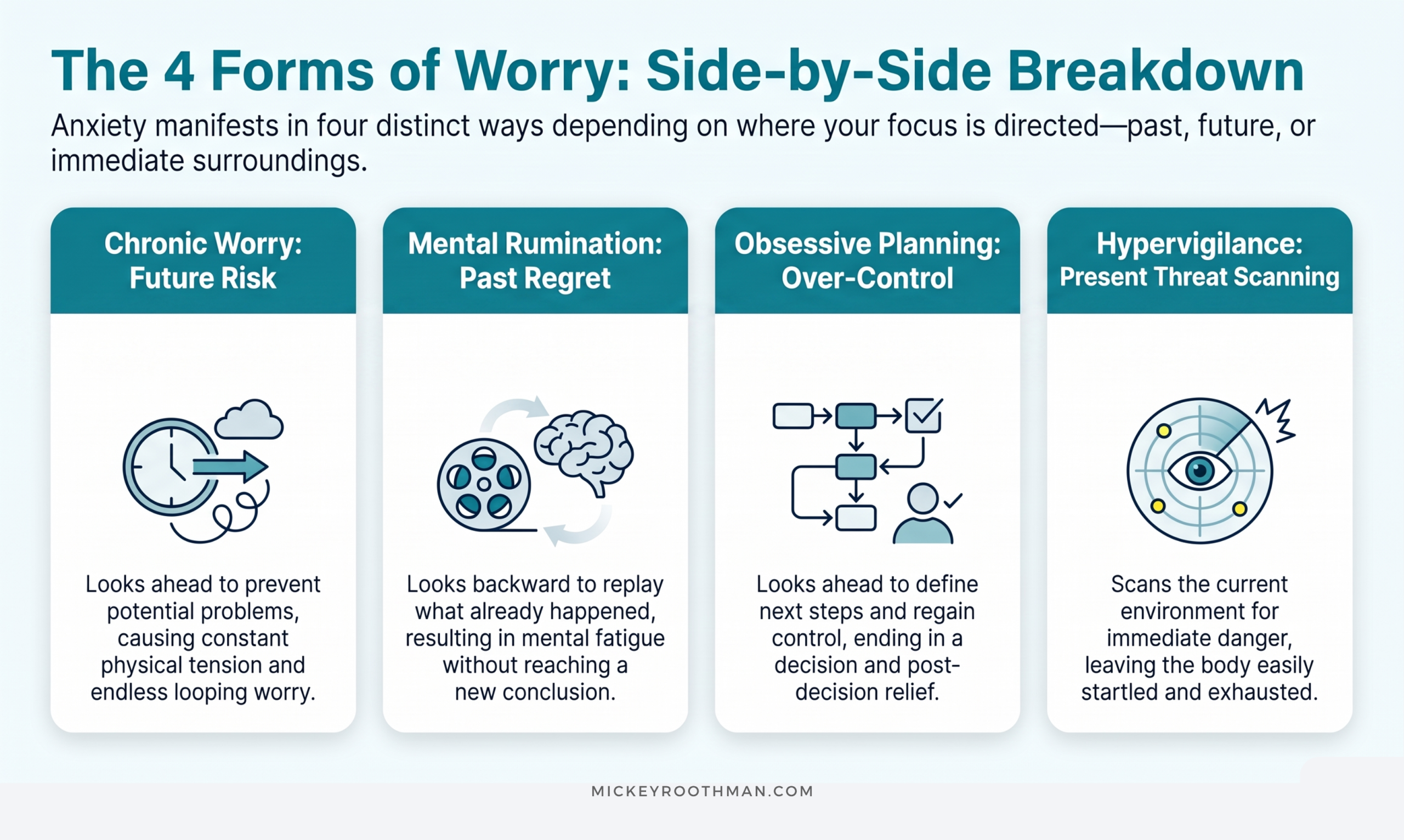
We tend to throw all of these different uncomfortable mental states into one giant bucket and label it “overthinking.” But in behavioral psychology and cognitive neuroscience, your brain’s actually cycling through four very distinct types of worry: Chronic Worry, Mental Rumination, Obsessive Planning, and Environmental Hypervigilance.
While each loop feels identical from the inside: flooding your body with restlessness and keeping your brain on high alert, they look in completely different directions, seek different goals, and actually require entirely different cognitive circuit breakers to silence and shut down.
Understanding which of the four loops your brain’s running in a given moment, is the ultimate key to turning off the noise, regaining emotional control, and finally getting a full night’s sleep.
Download Infographic Here
1. Chronic Worry -The Future-Focused “What-If” Machine
Worry is an anticipatory mental pattern directed exclusively toward the future. It’s driven by uncertainty and fueled by potential catastrophes that haven’t occurred yet.
Where Your Mind “Looks”:
Directly ahead into tomorrow, next month, or five years from now.
What Your Brain Is Trying To Do:
Worry is your brain’s attempt at proactive threat management. When your amygdala (the brain’s emotional alarm center) senses that an upcoming event contains unknown variables, it prompts your prefrontal cortex to construct dozens of hypothetical disaster scenarios. The underlying logic is simple: “If I can predict every single thing that could go wrong, I won’t be caught off guard.”
Real-World Example:
You see a calendar invite appear from HR titled “Quick Catch-Up,” scheduled for tomorrow afternoon. Even though your recent work’s been stellar, your mind instantly spins a web of hypothetical disasters: “What if layoffs are starting? What if I miscalculated our quarterly figures? Should I start updating my resume right now?”
The Neurological Trap:
Because worrying feels like you’re actively working on a problem, your brain misinterprets the mental strain as productive preparation. It rewards the habit with a temporary illusion of control; all the while still continuously pumping cortisol into your bloodstream and stacking up physical tension in your shoulders.

2. Mental Rumination – The Past-Focused “Why-Me” Replay
Rumination is a retrospective mental loop directed entirely toward the past. Rather than anticipating future risks, rumination continuously re-examines past events, mistakes, or perceived awkward interactions
Where Your Mind “Looks”:
Backwards into yesterday, last week, or even years or decades into your past.
What Your Brain Is Trying To Do:
While worry attempts to control the future, rumination attempts to rewrite history or assign personal blame. Driven by feelings of shame, regret, or grief, your brain enters an endless analytical loop, operating under the false belief that if you replay an uncomfortable conversation just one more time from a slightly different angle, you’ll unlock a hidden insight that retroactively erases the emotional discomfort.
Real World Example:
You left a team Zoom call three hours ago, but you’re still sitting on the couch replaying the exact moment you stumbled over your presentation slide. “Why didn’t I phrase that better? Everyone probably noticed how nervous I looked. Sarah smiled right after I spoke. Was she laughing at me?”
The Neurological Trap:
Unlike healthy self-reflection, which leads to a clear insight or closure, rumination never reaches a satisfying conclusion. It simply deepens the neural pathway of self-criticism, dragging your mood down and convincing you that past errors define your current worth.
3. Obsessive Planning – The Control-Driven “Action” Trap
Planning is a future-oriented cognitive process designed to organize tasks and define next steps. When functioning healthily, planning is a vital executive skill. However, when hijacked by underlying anxiety, it transforms into Obsessive Planning – a subtle, sneaky form of worry disguised as productivity.
Where The Mind “Looks”:
Toward future projects, schedules, logistics, spreadsheets, and task lists.
What Your Brain Is Trying To Do:
Obsessive planning seeks to eliminate the discomfort of life’s unpredictability by micromanaging every single detail. It promises that if you create the ultimate color-coded schedule, research twenty different product reviews, or draft every possible email response in advance, nothing unexpected can disrupt your peace.
Real-World Example:
Instead of relaxing on a Sunday evening, you spend three straight hours building a hyper-detailed, minute-by-minute itinerary for an upcoming family weekend, frantically opening twenty browser tabs to research dinner options, traffic predictions, and backup indoor activities in case it rains.
The Neurological Trap:
Planning feels responsible and disciplined, which makes it hard to recognize as an anxiety habit. However, when planning is driven by fear rather than genuine necessity, completing the plan doesn’t bring peace; it simply exposes five new potential logistical problems to fixate on.

4. Hypervigilance – The Present Moment “Danger-Scan”
Hypervigilance is a state of heightened sensory awareness directed at your immediate environment right now. Unlike worry or rumination, which live in your thoughts, hypervigilance lives in your physical nervous system.
Where Your Mind “Looks”:
Outward into your immediate surroundings, phone screens, physical sensations, or interpersonal cues.
What Your Brain Is Trying To Do:
Hypervigilance seeks to detect instant, incoming threats before they land. Rooted in past stress or chronic overload, your autonomic nervous system remains stuck in a fight-or-flight state, scanning every room, Slack message tone, or physical symptom for signs of impending conflict or danger.
Real-World Example:
Your partner or roommate responds to your text with a short, one-word answer like “Okay”. Your chest instantly tightens, your heart rate accelerates, and you spend the next twenty minutes scrutinizing every interaction from the morning to figure out if they’re secretly furious with you.
The Neurological Trap:
Hypervigilance drains immense physical and mental energy. Because your nervous system is constantly looking for threats, it interprets totally neutral signals like for example a delayed email response, a quiet tone of voice, or a sudden floorboard sound, as active danger – keeping you physically exhausted yet mentally wired.
Break The Worry Loop – The 3 Step Circuit Breaker
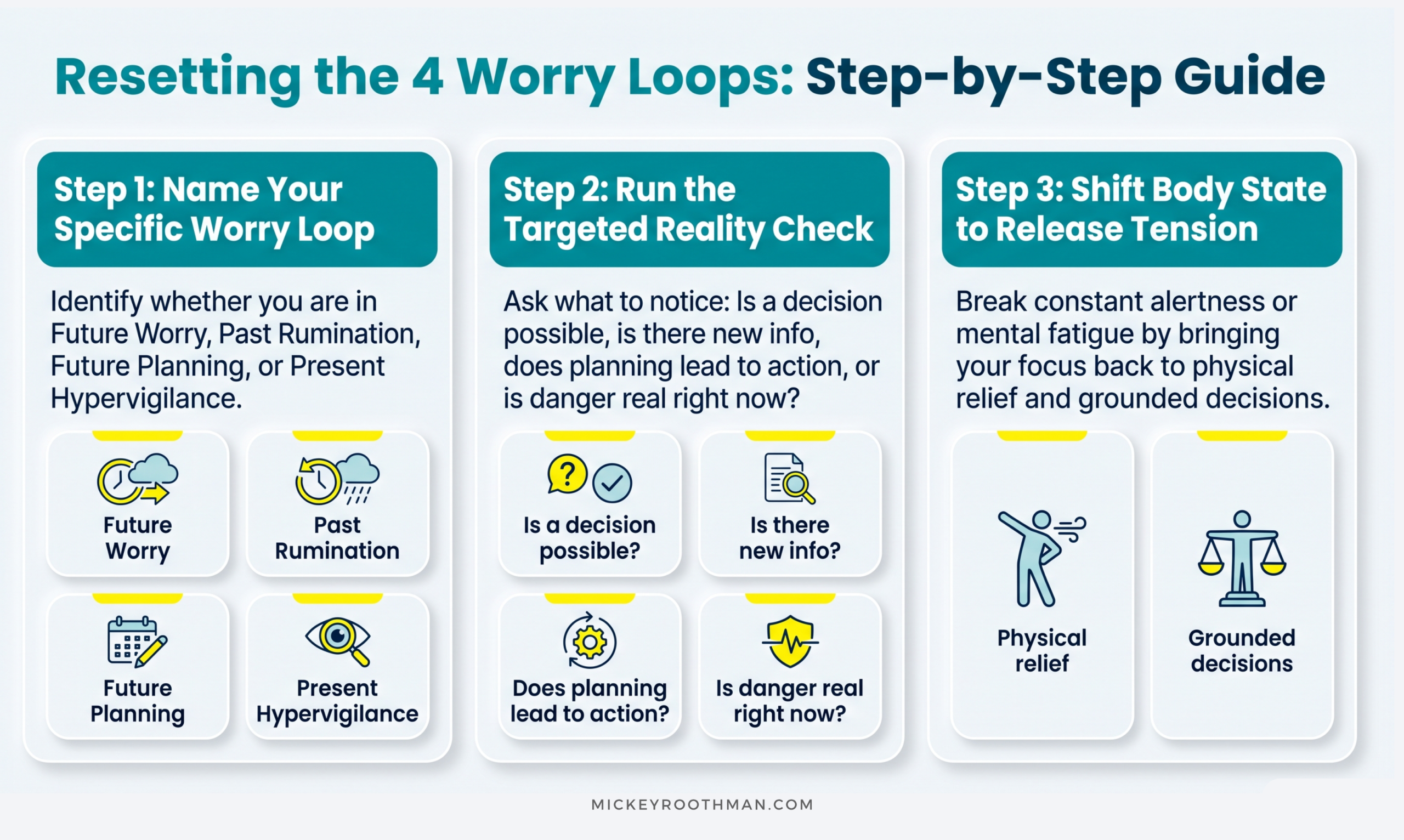
Regardless of which loop your brain is currently running, trying to brute-force yourself into not thinking never works. Instead, use this 3-step evidence-based CBT protocol to break the momentum:
Download Infographic Here
Step 1: Name The Loop Out Loud
The moment you feel your mind spinning, step back and label the exact pattern running:
- “This is future worry spinning hypothetical stories.”
- “This is past rumination replaying yesterday.”
- “This is obsessive planning trying to force control.”
- “This is hypervigilance scanning for danger that isn’t here.”
By naming the process out loud, you practice cognitive defusion; a core principle in Cognitive Behavioral Therapy (CBT) and Acceptance and Commitment Therapy (ACT).
Labeling shifts brain activity away from the emotional amygdala and reactivates the rational prefrontal cortex, creating instant emotional breathing room.
Step 2: The 3-Minute Reality & Action Check
Next, ask your mind the specific diagnostic question tailored to your active loop:
For Worry or Planning:
“Can I make a physical decision or take a 2-minute action right now?”
If yes, write down the single next step and schedule it.
If no, declare the topic off-limits until daytime hours.
For Rumination:
“Is there any new information to discover here, or am I just punishing myself?”
Recognize that replaying the tape won’t change the past, and grant yourself permission to step away.
For Hypervigilance:
“Am I in physical danger right now in this room?”
Orient your eyes to three solid objects around you to anchor your brain in present safety.
Step 3: Somatic 4-7-8 Breathing (Nervous System De-escalation)
Because worry loops trick your body into thinking you’re in physical danger, you must send a physiological safety signal down your Vagus Nerve to shut down the adrenaline pipeline. And this is a fast and effective way that you can do anywhere, to deliver that signal:
- Inhale quietly through your nose for 4 seconds.
- Hold your breath gently for 7 seconds.
- Exhale slowly and completely through your mouth for 8 seconds, letting out a soft “whoosh.”
Repeat this cycle four times. The extended 8-second exhale activates your parasympathetic nervous system, slowing your heart rate and signaling to your brain that it’s safe to power down.
Key Takeaways:
- Not All Overthinking Is the Same – Overthinking manifests as Chronic Worry (future threat), Mental Rumination (past regret), Obsessive Planning (over-control), or Hypervigilance (present threat-scanning).
- Worry Offers False Protection – Your brain runs these loops because it believes they offer safety, control, or resolution—even though they actually produce physical exhaustion and mental fatigue.
- Labeling Breaks the Spell – Simply naming the specific loop out loud detaches your identity from the thought and reactivates your rational brain.
- Grounding Restores Calm – True relief comes from shifting out of the mental loop using targeted diagnostic questions and somatic nervous system grounding.
Frequently Asked Questions:
Can my brain cycle through multiple types of worry in a single evening?
Absolutely. It’s very common for hypervigilance (noticing a colleague’s blunt text) to trigger past rumination (“I always ruin workplace relationships”), which then escalates into future worry (“I’m going to get fired”), ending in late-night obsessive planning (“I need to rewrite all my project guidelines tonight”). Using Step 1 to label each shift helps untangle the web.
How do I tell the difference between healthy planning and obsessive planning?
Healthy planning ends in a concrete decision and a sense of relief. Obsessive planning feels frantic, involves endless researching or tweaking without settling on an outcome, and leaves you feeling more anxious than when you started.
What should I do if I wake up at 2 AM stuck in one of these loops?
Don’t stay in bed trying to “fight” the thought. Sit up, turn on a dim light, and spend 3 minutes writing the thoughts onto a physical notepad. Once written down, tell yourself: “This is safely stored on paper. My brain’s off-duty until 9:00 AM.” Then perform four rounds of 4-7-8 breathing.
If you enjoyed this blog and know someone who would get value from it as well, please hit the share button now.
Ready to dive deeper? Check out the Breakthrough Podcast Here


 So its one of “those” days where everything that could possibly go wrong; does, and your emotions are off the charts, in fact your emotional well being seems severely under attack and at risk.
You wake up only to see that its 06:30 AM and that’s the time you’re already supposed to be leaving for work. Your alarm clock didn’t go off for some inexplicable reason and no matter what you do, you’re going to be late!
You hustle to shove yourself into the outfit you luckily laid out for work already last night, but as you grab your coffee to get one sip in on the way out, you spill it all over your brand new, crisp white Chanel shirt.
So you rush to change only to find that your back-up preference is in the washing basket and your washing day is only tomorrow..
You eventually make it to the car with no further delays only to realize that you forgot to fill up your tank last night and the petrol light seems like its deliberately trying to be snarky flashing the words “EMPTY” in big red letters at you!
You finally make it to the office and it appears that all hell had broken loose in the mere 10 minutes that you were late.
To top it all off, the boss is in a bad mood and glaring at you (you think its probably because you’re late) and he piles yet another crisis that is on deadline onto you.
At this point the “drama queen” inside your head revs it up a gear, kick into overdrive and she’s like:
“He’s probably testing me to see if I will manage. He’s just setting me up to fail. He never liked me anyway. I bet he is just looking for a reason to fire me and my being late just added another bullet to his arsenal. Oh my gosh how will I find work again. The job market is so over-saturated as it is. I’m going to starve and end up living as a bum on the street. Why didn’t I just take my phone in last time it did that? Oh yes it was because I had to work late to finish that project. That my boss doesn’t remember. He doesn’t even see the value I bring to the team and all of the extra things I do. Why the heck do I do them anyway? They don’t appreciate me. No one does. Its because I’m not good enough. Just like my ex. Nothing is ever good enough. Maybe I should just resign before he fires me” – EASY THERE GIRL! STOP & BREATHE!
We’ve all had a day, at times a week and some are even convinced a life like this, right? Okay that may have been a little bit over dramatized but you get the gist. And it serves the point I’m getting to.
When you read that, how did it make you feel? A little anxious perhaps? Did your heart start racing or your stomach turn into a knot? Changes are that it absolutely did.
That wasn’t even happening for real and it wasn’t even happening to YOU, yet your body reacted to it physically anyway and here’s why.
So its one of “those” days where everything that could possibly go wrong; does, and your emotions are off the charts, in fact your emotional well being seems severely under attack and at risk.
You wake up only to see that its 06:30 AM and that’s the time you’re already supposed to be leaving for work. Your alarm clock didn’t go off for some inexplicable reason and no matter what you do, you’re going to be late!
You hustle to shove yourself into the outfit you luckily laid out for work already last night, but as you grab your coffee to get one sip in on the way out, you spill it all over your brand new, crisp white Chanel shirt.
So you rush to change only to find that your back-up preference is in the washing basket and your washing day is only tomorrow..
You eventually make it to the car with no further delays only to realize that you forgot to fill up your tank last night and the petrol light seems like its deliberately trying to be snarky flashing the words “EMPTY” in big red letters at you!
You finally make it to the office and it appears that all hell had broken loose in the mere 10 minutes that you were late.
To top it all off, the boss is in a bad mood and glaring at you (you think its probably because you’re late) and he piles yet another crisis that is on deadline onto you.
At this point the “drama queen” inside your head revs it up a gear, kick into overdrive and she’s like:
“He’s probably testing me to see if I will manage. He’s just setting me up to fail. He never liked me anyway. I bet he is just looking for a reason to fire me and my being late just added another bullet to his arsenal. Oh my gosh how will I find work again. The job market is so over-saturated as it is. I’m going to starve and end up living as a bum on the street. Why didn’t I just take my phone in last time it did that? Oh yes it was because I had to work late to finish that project. That my boss doesn’t remember. He doesn’t even see the value I bring to the team and all of the extra things I do. Why the heck do I do them anyway? They don’t appreciate me. No one does. Its because I’m not good enough. Just like my ex. Nothing is ever good enough. Maybe I should just resign before he fires me” – EASY THERE GIRL! STOP & BREATHE!
We’ve all had a day, at times a week and some are even convinced a life like this, right? Okay that may have been a little bit over dramatized but you get the gist. And it serves the point I’m getting to.
When you read that, how did it make you feel? A little anxious perhaps? Did your heart start racing or your stomach turn into a knot? Changes are that it absolutely did.
That wasn’t even happening for real and it wasn’t even happening to YOU, yet your body reacted to it physically anyway and here’s why.
 Let me explain. So you already know that our thoughts cause our emotions. But what are emotions? Just like thoughts, emotions are vibrational energy. And Science and in Quantum circles it has already been proven that energy attracts the same energy to itself. So whatever vibrational energy you are sending out through your emotions is really what you’re attracting more of to yourself then.
Right about now you may also be having a little “AHA’ moment going on inside of you as to why it is that when one bad thing happens it can feel like it caused a snowball effect causing an avalanche of sh*t bombs rolling your way. But, this doesn’t have to happen. See if you re-calibrated your energy after the first shitty thing happened, you wouldn’t have attracted more drama into your experience.
Re-calibrate your what now? Well basically if you chose a better thinking thought in that moment like: “Well, stuff happens. I couldn’t control the alarm clock not going off. I’m never late and I’m a hard worker so I’m sure my boss will understand. Everything happens for a reason and I am thankful for whatever this experience was here to teach me or protect me from” , none of that other stuff would have happened.
You would have pivoted from a low negative vibrational energy (thoughts and feelings) to a high vibrational energy in an instant and that would have been the end of it. The rest of your day would have gone a lot smoother and you would have had a lot more joy and inner peace too.
So what we attract then really starts with our thoughts. But here’s the big whopper! We think around 80 000 thoughts a day and only 5% of those thoughts are thoughts we are consciously aware of. The other 95% are subconscious thought patterns based on our upbringing, past experiences and beliefs that are running on auto-pilot.
Hang ten now, don’t get discouraged just yet!
The title of this blog said that this was about showing you how to do it and I always deliver on my promises.
Okay, so if we we’re not even aware of our thoughts like 95% of the time and they’re running on auto pilot, how do we then know when we are thinking a low vibrational thought that will attract more low vibrational experiences to us?
QUE DRUM ROLE PLEASE ….. Through our EMOTIONS!
Like I said in the beginning, our emotions are really our GPS for what we are busy attracting to ourselves and creating in our lives. And lets face it. It’s a heck of a lot easier to be aware of how you feel than it is to try and manage 80 000 thoughts a day of which 95% are subconsciously on autopilot.
We usually know when we don’t feel well emotionally because our body reacts to it physically in manifestations like stomach knots, headaches, neck spasms, ground down teeth, chest pains and so much more. The important one to mention here is that it may manifest as debilitating and even serious physical illnesses.
Emotions are energy but they also cause chemicals to form in our body. This is really the body’s way of trying to protect us, our built in protection and self preservation mechanism. But these chemicals were meant to protect us for short term threats we experience in our environment and they were never meant to be present for extended periods of time. So when we are not aware of low vibrational thoughts causing low vibrational feelings and manifesting as toxins in our body that aren’t dealt with over an extended period of time, our body will eventually warn us that something needs to get “processed” and worked on that is causing it to malfunction in the form of illness.
if we can learn to become aware of our emotions and to process them, we can nip it in the bud straight away and not wait for more bad experiences to show up or for physical illness to set in to tell us that we are headed for disaster.
Let me explain. So you already know that our thoughts cause our emotions. But what are emotions? Just like thoughts, emotions are vibrational energy. And Science and in Quantum circles it has already been proven that energy attracts the same energy to itself. So whatever vibrational energy you are sending out through your emotions is really what you’re attracting more of to yourself then.
Right about now you may also be having a little “AHA’ moment going on inside of you as to why it is that when one bad thing happens it can feel like it caused a snowball effect causing an avalanche of sh*t bombs rolling your way. But, this doesn’t have to happen. See if you re-calibrated your energy after the first shitty thing happened, you wouldn’t have attracted more drama into your experience.
Re-calibrate your what now? Well basically if you chose a better thinking thought in that moment like: “Well, stuff happens. I couldn’t control the alarm clock not going off. I’m never late and I’m a hard worker so I’m sure my boss will understand. Everything happens for a reason and I am thankful for whatever this experience was here to teach me or protect me from” , none of that other stuff would have happened.
You would have pivoted from a low negative vibrational energy (thoughts and feelings) to a high vibrational energy in an instant and that would have been the end of it. The rest of your day would have gone a lot smoother and you would have had a lot more joy and inner peace too.
So what we attract then really starts with our thoughts. But here’s the big whopper! We think around 80 000 thoughts a day and only 5% of those thoughts are thoughts we are consciously aware of. The other 95% are subconscious thought patterns based on our upbringing, past experiences and beliefs that are running on auto-pilot.
Hang ten now, don’t get discouraged just yet!
The title of this blog said that this was about showing you how to do it and I always deliver on my promises.
Okay, so if we we’re not even aware of our thoughts like 95% of the time and they’re running on auto pilot, how do we then know when we are thinking a low vibrational thought that will attract more low vibrational experiences to us?
QUE DRUM ROLE PLEASE ….. Through our EMOTIONS!
Like I said in the beginning, our emotions are really our GPS for what we are busy attracting to ourselves and creating in our lives. And lets face it. It’s a heck of a lot easier to be aware of how you feel than it is to try and manage 80 000 thoughts a day of which 95% are subconsciously on autopilot.
We usually know when we don’t feel well emotionally because our body reacts to it physically in manifestations like stomach knots, headaches, neck spasms, ground down teeth, chest pains and so much more. The important one to mention here is that it may manifest as debilitating and even serious physical illnesses.
Emotions are energy but they also cause chemicals to form in our body. This is really the body’s way of trying to protect us, our built in protection and self preservation mechanism. But these chemicals were meant to protect us for short term threats we experience in our environment and they were never meant to be present for extended periods of time. So when we are not aware of low vibrational thoughts causing low vibrational feelings and manifesting as toxins in our body that aren’t dealt with over an extended period of time, our body will eventually warn us that something needs to get “processed” and worked on that is causing it to malfunction in the form of illness.
if we can learn to become aware of our emotions and to process them, we can nip it in the bud straight away and not wait for more bad experiences to show up or for physical illness to set in to tell us that we are headed for disaster.
 Now you may be thinking, “what about all the other times I didn’t do this because I didn’t know about it yet? “Fact is there may be some old trapped emotions in your body that you need to release.
Its time for you to do an Emotional Detox! Clean the slate and pivot!
You’ll experience tremendous emotional freedom and as a bonus your energy levels and health will increase as well. Overall you’ll just be feeling GREAT and attracting more of the experiences you DO want into your life as a result.
Like everything in life it takes some commitment and action on your part, but I promise you it is easy to do and so damn worth it!
Now you may be thinking, “what about all the other times I didn’t do this because I didn’t know about it yet? “Fact is there may be some old trapped emotions in your body that you need to release.
Its time for you to do an Emotional Detox! Clean the slate and pivot!
You’ll experience tremendous emotional freedom and as a bonus your energy levels and health will increase as well. Overall you’ll just be feeling GREAT and attracting more of the experiences you DO want into your life as a result.
Like everything in life it takes some commitment and action on your part, but I promise you it is easy to do and so damn worth it!

 Wholeness is something we all desire. Yes, even that person you look up to or secretly envy whose life just looks amazing on social media.
The dictionary describes wholeness as:
1) the state of forming a complete and harmonious whole; unity
2) the state of being unbroken or undamaged.
But what is wholeness really?
After almost 10 000 hours of one on one coaching and mentoring with clients, I would say that what represents a state of wholeness to each of us is different.
For some wholeness is represented by inner peace, direction & purpose and for others it is represented by their external circumstances and achievements.
Wholeness is something we all desire. Yes, even that person you look up to or secretly envy whose life just looks amazing on social media.
The dictionary describes wholeness as:
1) the state of forming a complete and harmonious whole; unity
2) the state of being unbroken or undamaged.
But what is wholeness really?
After almost 10 000 hours of one on one coaching and mentoring with clients, I would say that what represents a state of wholeness to each of us is different.
For some wholeness is represented by inner peace, direction & purpose and for others it is represented by their external circumstances and achievements.
 One of my favorite quotes by the Sufi Poet Rumi is: “Everything in the universe is within you. Ask all from yourself.”
Whatever represents a state of wholeness to you personally there is only one path to achieving it ….. turning inward!
Wholeness is an internal state. It can only be achieved through our own actions, choices, thoughts & beliefs and never by external factors outside of our control.
Further below n this blog I share the 7 Principles to achieving tangible, lasting wholeness that I learned from the poet and teacher Rumi. I modified them slightly based on my own experiences and research and have integrated these principles with great results and success into my own life.
The results I’ve seen from implementing these 7 principles on a daily basis in my own life as well as the lives of my coaching clients has been consistent and nothing short of miraculous!
One of my favorite quotes by the Sufi Poet Rumi is: “Everything in the universe is within you. Ask all from yourself.”
Whatever represents a state of wholeness to you personally there is only one path to achieving it ….. turning inward!
Wholeness is an internal state. It can only be achieved through our own actions, choices, thoughts & beliefs and never by external factors outside of our control.
Further below n this blog I share the 7 Principles to achieving tangible, lasting wholeness that I learned from the poet and teacher Rumi. I modified them slightly based on my own experiences and research and have integrated these principles with great results and success into my own life.
The results I’ve seen from implementing these 7 principles on a daily basis in my own life as well as the lives of my coaching clients has been consistent and nothing short of miraculous!


 As I mentioned earlier in this blog post I recently dove deeper into this topic in a podcast episode on

 If you believe that it has to be difficult and that you have to struggle to have the life that you want, I want to assure you today from experience that you don’t have to struggle to be happy, successful or whatever it is you desire.
I’ve seen proof of it over and over again in my own life and in the lives of many of my clients once they lay down and let go of this belief that has been projected onto us by society.
I want you to choose today, right here right now, to let go of that idea and that belief. I want you to choose today to believe that you can create and have the life that you want with total ease and joy!
If you believe that it has to be difficult and that you have to struggle to have the life that you want, I want to assure you today from experience that you don’t have to struggle to be happy, successful or whatever it is you desire.
I’ve seen proof of it over and over again in my own life and in the lives of many of my clients once they lay down and let go of this belief that has been projected onto us by society.
I want you to choose today, right here right now, to let go of that idea and that belief. I want you to choose today to believe that you can create and have the life that you want with total ease and joy!


![[A POWERFUL PRAYER] When you struggle to let go & let God](https://mickeyroothman.com/wp-content/uploads/2019/07/Untitled-design-20-1200x350-c-default.png)
 “Let go and let God” is sometimes much easier said than done.
As a strategist by profession and by nature trusting, letting go and relinquishing control was probably one of the hardest things for me to learn on my Spiritual awakening and enlightenment journey.
And its something I come across almost daily in my coaching practice with my clients and still face at times in my own life as well.
Even when I consciously make the decision to release the things I need help with to my Higher Power, detach from the how and the outcome and just trust, I still find myself in fear, anxiety and stress over it at times.
Especially if nothing has happened or changed within the amount of time I wanted it to as yet, I find myself in fear, stress or anxiety over it or even back to trying to control and manipulate the outcome I desire regarding that thing yet again.
This can be very frustrating because it happens so subtly and sub-consciously that I usually don’t even realize it until I’m knee deep back in the fear, anxiety, stress and trying to control it again.
Here’s the thing, this is very normal, especially when we can recognize that old patterns don’t just change over night and that we are still learning to fully trust and fully let go.
Our logical, reasoning ego mind doesn’t like this at all and wants to protect us from disappointment, so it tells us that we have to be in fear or actively trying to change or control that situation to prevent being disappointed and it is masked as that these thoughts are really just trying to protect us.
Unlearning our default way of thinking that we need to do and control everything or it won’t happen and silencing our ego mind is a process. The more we practice surrender to our Higher Power, the easier and more comfortable it will get. And the more comfortable we get with doing so, the more divine solutions and shifts of those things that we surrender and release to our Higher Power will start showing up in our reality!
One of the biggest mistakes we make when we find ourselves back in fear, stress, anxiety and trying to control & manipulate the outcome we want yet again, is to judge ourselves or get frustrated and angry with ourselves for doing so and not being able to just let go and trust.
But here’s the thing. When we get frustrated, angry and judgmental with ourselves for it, this brings even more resistance to the change that we desire. So its important for us to have compassion with ourselves, knowing that we are learning, growing and evolving daily to release our old patterns, and that it is okay if we don’t get it 100% right at first.
I have a powerful prayer that I say immediately each time that I find myself back in any negative thought patterns and feelings or trying to control or manipulate the outcome of something that I’ve released to my Higher Power to sort out and bring the divine solution to.
This powerful prayer will help you to fully surrender, trust & detach from the outcome and the “how” every single time.
If you find yourself back in negative thoughts and emotions or controlling and manipulating that thing again, you can simply stop and choose again by putting your hand over your heart and saying this prayer: (You can customize it as you see fit for your particular situation)
“Let go and let God” is sometimes much easier said than done.
As a strategist by profession and by nature trusting, letting go and relinquishing control was probably one of the hardest things for me to learn on my Spiritual awakening and enlightenment journey.
And its something I come across almost daily in my coaching practice with my clients and still face at times in my own life as well.
Even when I consciously make the decision to release the things I need help with to my Higher Power, detach from the how and the outcome and just trust, I still find myself in fear, anxiety and stress over it at times.
Especially if nothing has happened or changed within the amount of time I wanted it to as yet, I find myself in fear, stress or anxiety over it or even back to trying to control and manipulate the outcome I desire regarding that thing yet again.
This can be very frustrating because it happens so subtly and sub-consciously that I usually don’t even realize it until I’m knee deep back in the fear, anxiety, stress and trying to control it again.
Here’s the thing, this is very normal, especially when we can recognize that old patterns don’t just change over night and that we are still learning to fully trust and fully let go.
Our logical, reasoning ego mind doesn’t like this at all and wants to protect us from disappointment, so it tells us that we have to be in fear or actively trying to change or control that situation to prevent being disappointed and it is masked as that these thoughts are really just trying to protect us.
Unlearning our default way of thinking that we need to do and control everything or it won’t happen and silencing our ego mind is a process. The more we practice surrender to our Higher Power, the easier and more comfortable it will get. And the more comfortable we get with doing so, the more divine solutions and shifts of those things that we surrender and release to our Higher Power will start showing up in our reality!
One of the biggest mistakes we make when we find ourselves back in fear, stress, anxiety and trying to control & manipulate the outcome we want yet again, is to judge ourselves or get frustrated and angry with ourselves for doing so and not being able to just let go and trust.
But here’s the thing. When we get frustrated, angry and judgmental with ourselves for it, this brings even more resistance to the change that we desire. So its important for us to have compassion with ourselves, knowing that we are learning, growing and evolving daily to release our old patterns, and that it is okay if we don’t get it 100% right at first.
I have a powerful prayer that I say immediately each time that I find myself back in any negative thought patterns and feelings or trying to control or manipulate the outcome of something that I’ve released to my Higher Power to sort out and bring the divine solution to.
This powerful prayer will help you to fully surrender, trust & detach from the outcome and the “how” every single time.
If you find yourself back in negative thoughts and emotions or controlling and manipulating that thing again, you can simply stop and choose again by putting your hand over your heart and saying this prayer: (You can customize it as you see fit for your particular situation)
![[FREE VIDEO]: So Your Life Transformation Results Didn’t Last – AGAIN! Here’s why!](https://mickeyroothman.com/wp-content/uploads/2019/03/2-1200x350-c-default.png)
 We’ve all been there, right?
We decide to go on a life transformation journey, become a better version of ourselves & be more positive. And then we start with the best of intentions to do whatever it takes to help us do just that!
We start doing affirmations, meditating, reading inspirational books, listening to inspirational podcasts and even enroll in a coaching program or two to help us get there.
And because we’re doing all of these things, our internal and external lives start shifting and we start seeing the RESULTS.
We start understanding more about who we are and why we are here.
We have some life altering aha-moments on the journey too and its REALLY AWESOME & EXCITING!
We feel like we are ON TOP OF THE WORLD!
But then suddenly, something happens and ….. BAM! Everything comes crashing down and we feel like everything we’ve learned and done didn’t last!
I’ve seen this happen to many people in my over a decade of coaching. And I’ve seen it happen to me in my own life as well.
Not just with life transformation tools and practices but with just about any new habit or skill that we try to implement into our lives.
We go onto a massive high but then it seems to all come crashing down at some point, which either leaves us feeling like it is impossible for us to change ourselves or our lives, like this stuff doesn’t work, or at the very least like it works but it just doesn’t seem to last.
What if I told you there’s a reason why this happens to so many people?
What if I told you there are ways you can ensure that the tools and practices you implement and the results you experience at first STICK?
We’ve all been there, right?
We decide to go on a life transformation journey, become a better version of ourselves & be more positive. And then we start with the best of intentions to do whatever it takes to help us do just that!
We start doing affirmations, meditating, reading inspirational books, listening to inspirational podcasts and even enroll in a coaching program or two to help us get there.
And because we’re doing all of these things, our internal and external lives start shifting and we start seeing the RESULTS.
We start understanding more about who we are and why we are here.
We have some life altering aha-moments on the journey too and its REALLY AWESOME & EXCITING!
We feel like we are ON TOP OF THE WORLD!
But then suddenly, something happens and ….. BAM! Everything comes crashing down and we feel like everything we’ve learned and done didn’t last!
I’ve seen this happen to many people in my over a decade of coaching. And I’ve seen it happen to me in my own life as well.
Not just with life transformation tools and practices but with just about any new habit or skill that we try to implement into our lives.
We go onto a massive high but then it seems to all come crashing down at some point, which either leaves us feeling like it is impossible for us to change ourselves or our lives, like this stuff doesn’t work, or at the very least like it works but it just doesn’t seem to last.
What if I told you there’s a reason why this happens to so many people?
What if I told you there are ways you can ensure that the tools and practices you implement and the results you experience at first STICK?
![[NEW BLOG] Science proves we see with our MIND and not with our eyes.](https://mickeyroothman.com/wp-content/uploads/2018/07/eyes-1200x350-c-default.jpg)